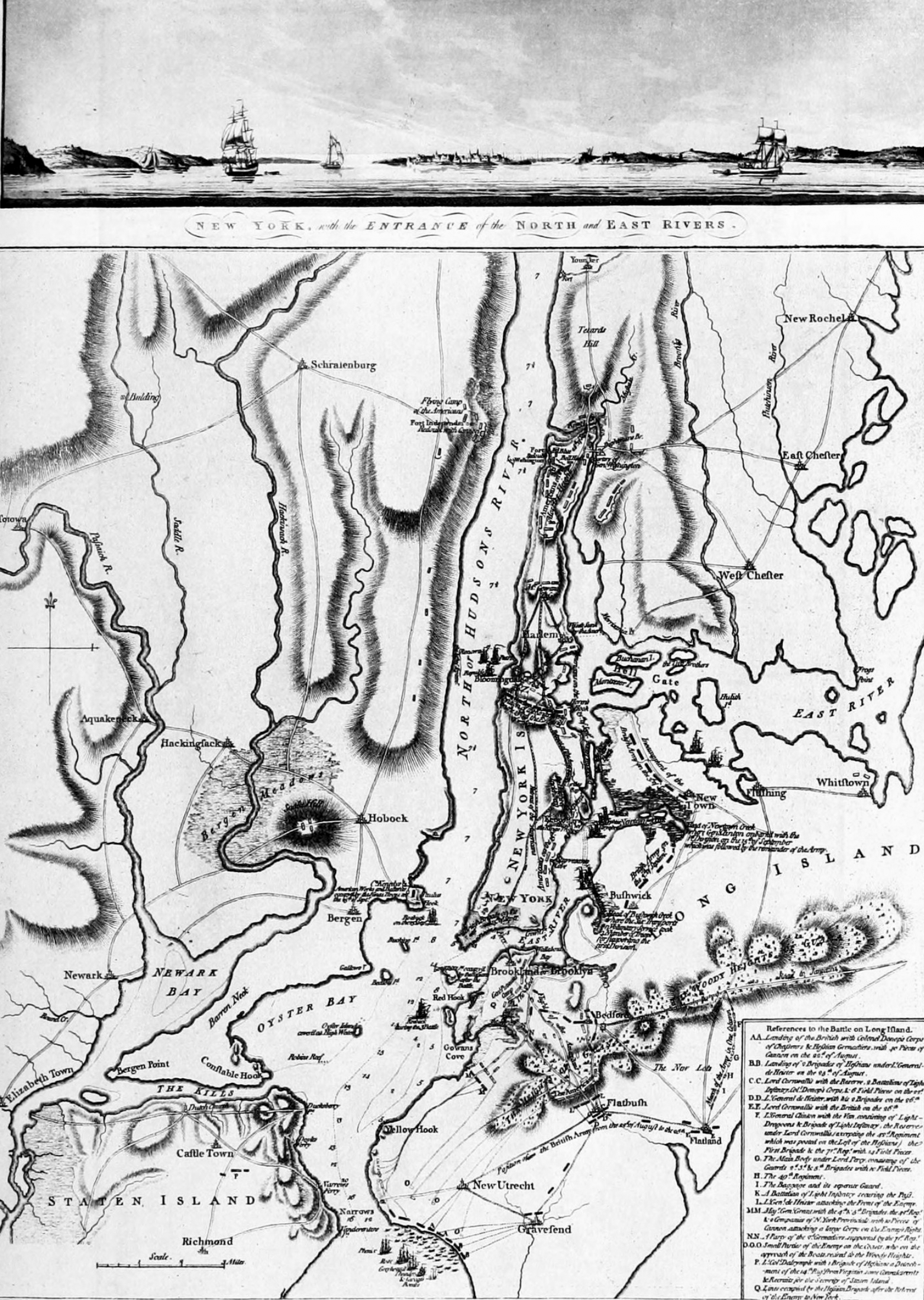
A Plan of New York Island, with part of Long Island, Staten Island & East New Jersey, with a particular Description of the Engagement on the Woody Heights of Long Island, between Flatbush and Brooklyn, on the 27th of August. This view, also known as The Howe War Plan, is of a copy that was published in England in October 1776. It notably shows the topography in and around New-York, including the Heights of Guan, over which the Battle of Brooklyn was fought. Towards the bottom of the map, the flotilla that transported the British and Hessian soldiers on August 22nd can be seen.
At daybreak on August 22nd, 1776, British ships that had been stationed off the coast of Staten Island, where thousands of British and Hessian troops had been preparing to invade Long Island, began moving into position to cover the crossing of the troops. Four frigates, including the Phoenix, Rose, Greyhound, and Rainbow, along with the bomb ketches Thunder and Carcass, sailed into the Bay as the soldiers began loading into smaller vessels.
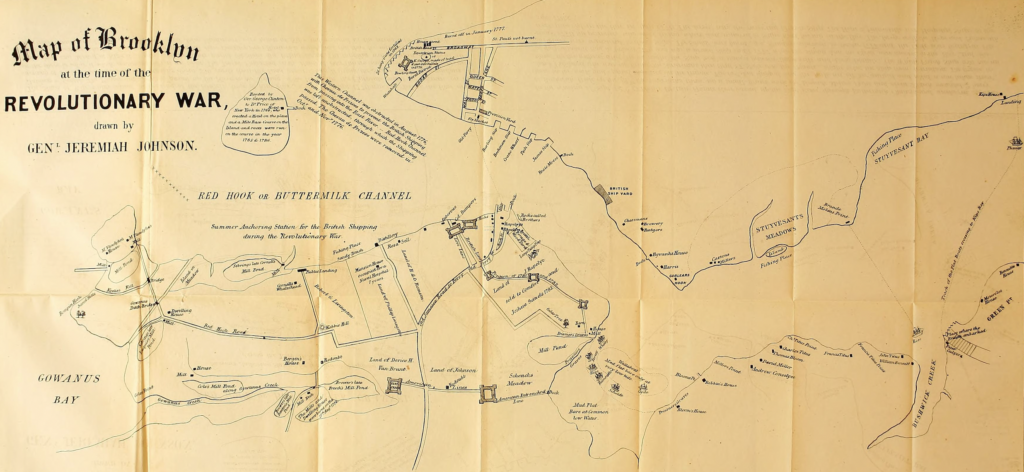
Map of Brooklyn at the time of the Revolutionary War, drawn by General Jeremiah Johnson. This view shows some of the fortifications that protected Brooklyn Heights in 1776, along with the enlargements and additions made by the British when they took control of Long Island. Two forts, Fort Greene and Fort Putnam (rather confusingly, this was later renamed to Fort Greene), protected the neck leading to the heights, which spanned only about a mile, and was surrounded on the north by Wallabout Bay, and on the south by the expansive Gowanus Creek. From D.T. Valentine’s Manual of the Corporation of the City of New York, 1858.
George Washington and his generals, still wary of a possible attack on York Island (Manhattan), had spent months fortifying positions on the island, centering on the formidable heights of Brooklyn, with strategic redoubts and soldiers protecting the Heights of Guan in the distance, a terminal moraine formed and carved millions of years ago by glaciers. Washington had received intelligence the night of the 21st that confirmed that preparations were underway, and that the British were, as he wrote to General William Heath, “upon the point of striking the long-expected stroke.”
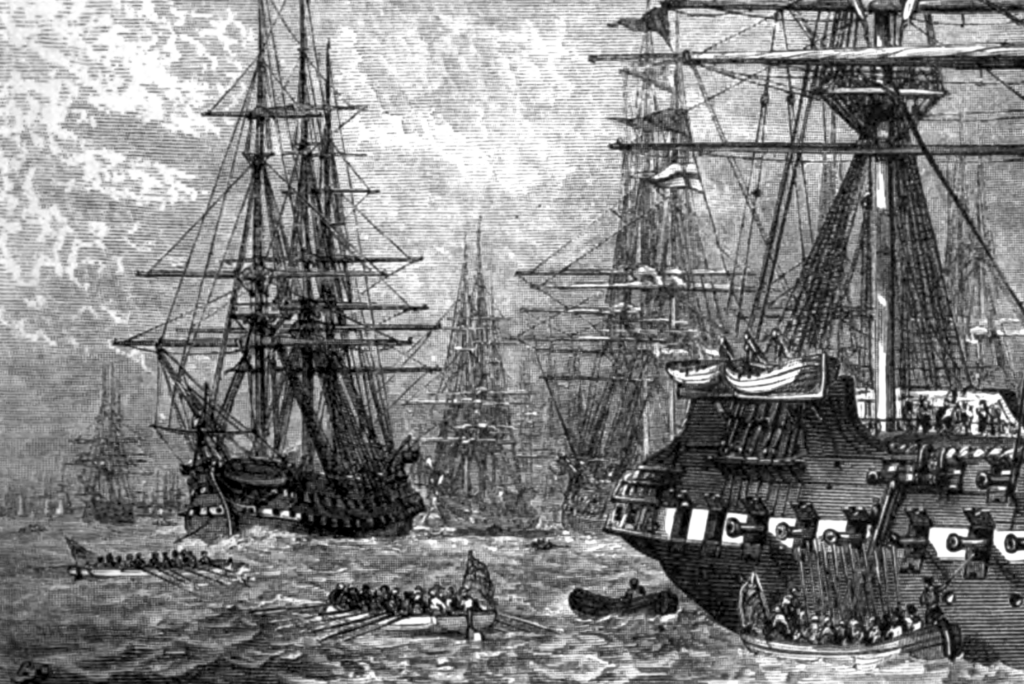
The British fleet off the coast of Staten Island. From Harper’s New Monthly Magazine, August 1876.
Led by General William Howe, the British were thoroughly informed by Tory allies such as Governor William Tryon and a network of Loyalist spies on both Staten and Long Island, and Howe, supported by his brother Admiral Richard Howe, had developed a plan for the invasion. By mid-August, the fleet included over 400 vessels, and was the largest British expeditionary force that had ever been assembled up to that point.
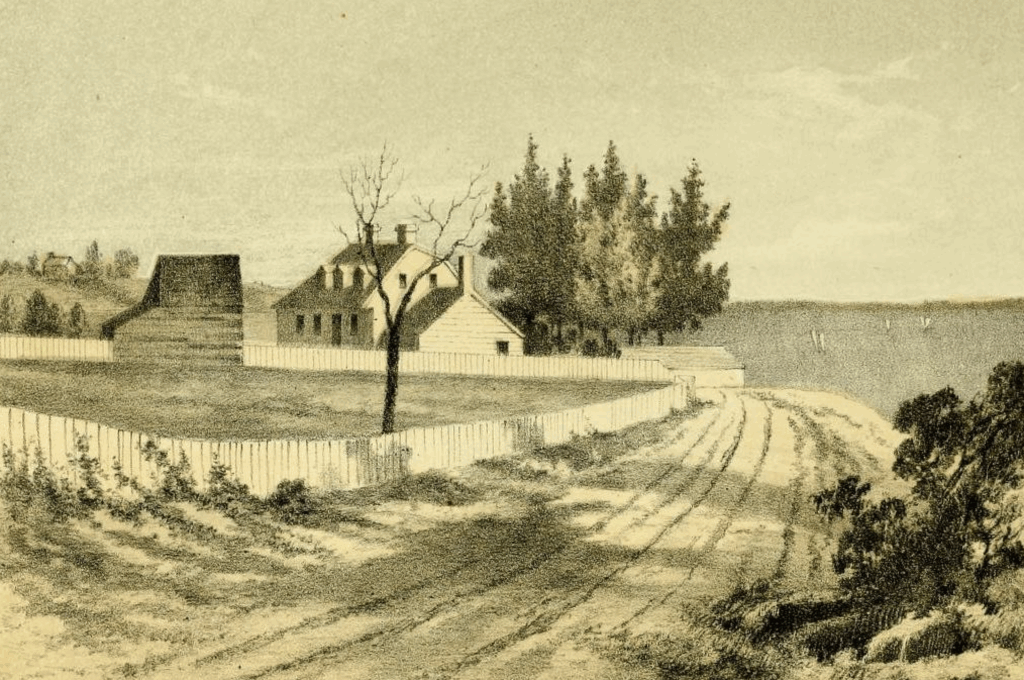
Denyse Denyse’s Ferry. In April 1776, the Patriot battery had fired on the HMS Asia, and the returning fire sent a cannonball through the Denyse house. From Historic and Antiquarian Scenes in Brooklyn and its Vicinity by Thomas W. Field.
Around 8 o’clock that morning, 4,000 soldiers had loaded into flat-boats, batteaux, and galleys for the first journey across the Narrows, landing along the wide, sandy beach near Denyse’s Ferry. A small battery had been built on a hill overlooking the ferry, upon which the guns of the Rainbow were trained. The two hundred or so American riflemen stationed nearby fired sporadically on the force before realizing that the sheer number of enemy troops massing on the coast was too great for their small force to attack. They withdrew to the Heights of Guan, although not before burning crops and killing cattle in their wake so the enemy could not benefit.
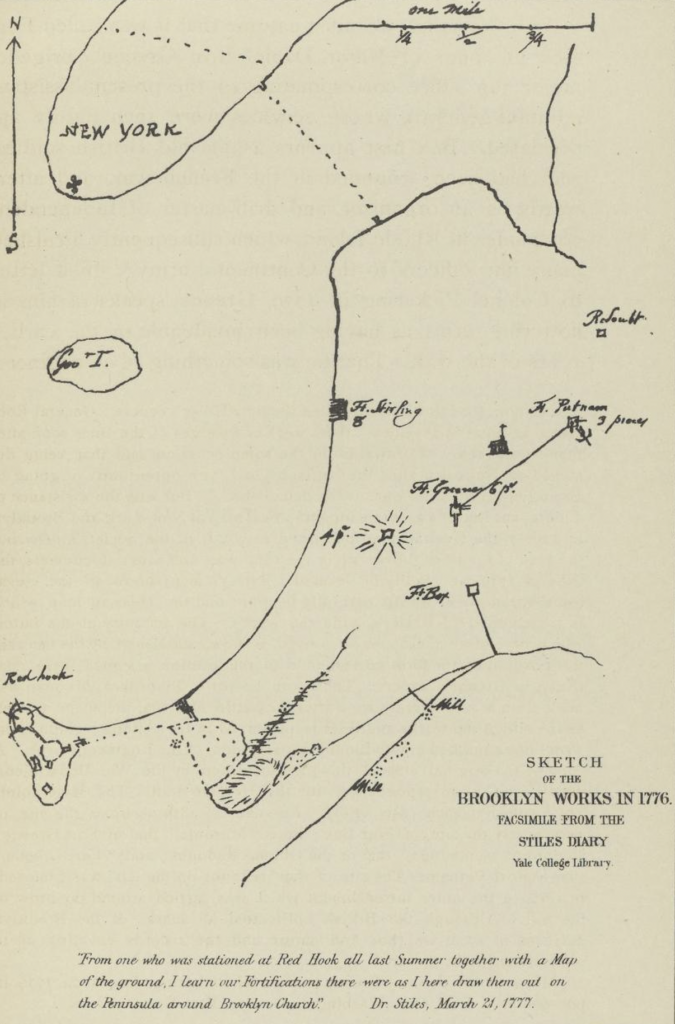
Sketch of the Brooklyn Works in 1776. This was drawn by Henry P. Johnson based on the memories of a soldier who fought at the battle. Fort Defiance is on the far left in Red Hook, and Fort Stirling, the largest of the forts that were constructed by the Americans, is up the Brooklyn coast. From The campaign of 1776 around New York and Brooklyn by Henry P. Johnson.
By noon, two additional groups had been brought across the span by the flotilla. An estimated 15,000 British and Hessian troops had disembarked on Long Island, which British officer Stephen Kemble noted was done “without the smallest opposition.” However, the Americans were closely watching the events, and alarms soon rang at Forts Sterling and Defiance, with Patriot troops being rapidly ferried across the East River and dispatched to guard the Brooklyn defenses.
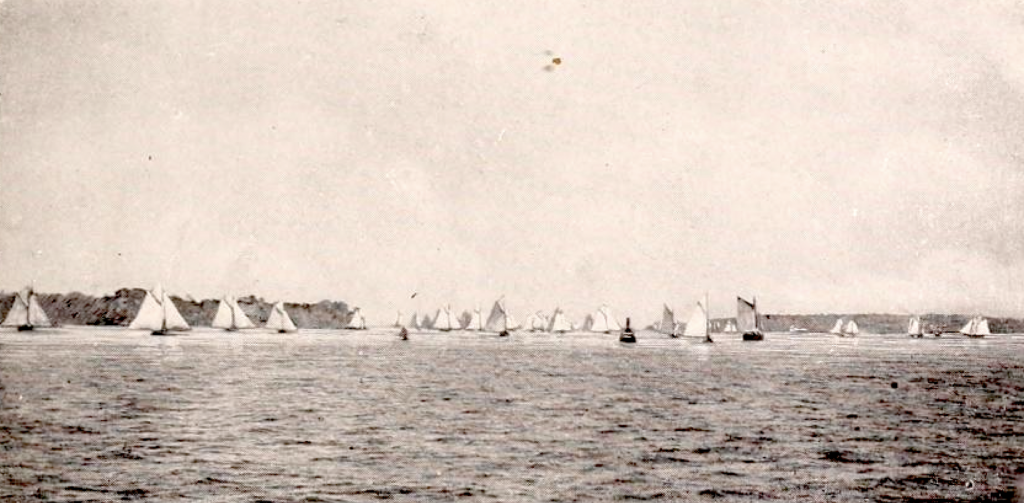
A view of the Narrows, 1898. From Leslie’s History of the Greater New York, Vol II by Daniel Van Pelt.
The British marched to the nearby village of New Utrecht, and General Howe made his headquarters at the home of Loyalist Simon Cortelyou. Generals Clinton and Cornwallis, along with Colonel Donop of the Hessians, continued on to the village of Gravesend, and then to Flatbush. The Americans along the Heights of Guan watched these movements closely, and Washington sent six regiments to reinforce General John Sullivan. Several small skirmishes occurred when the Americans periodically ducked out from the “Woody Heights” and fired upon the invaders. They received some cannon fire in return, but this did not bring about a significant general engagement, which was expected by some.
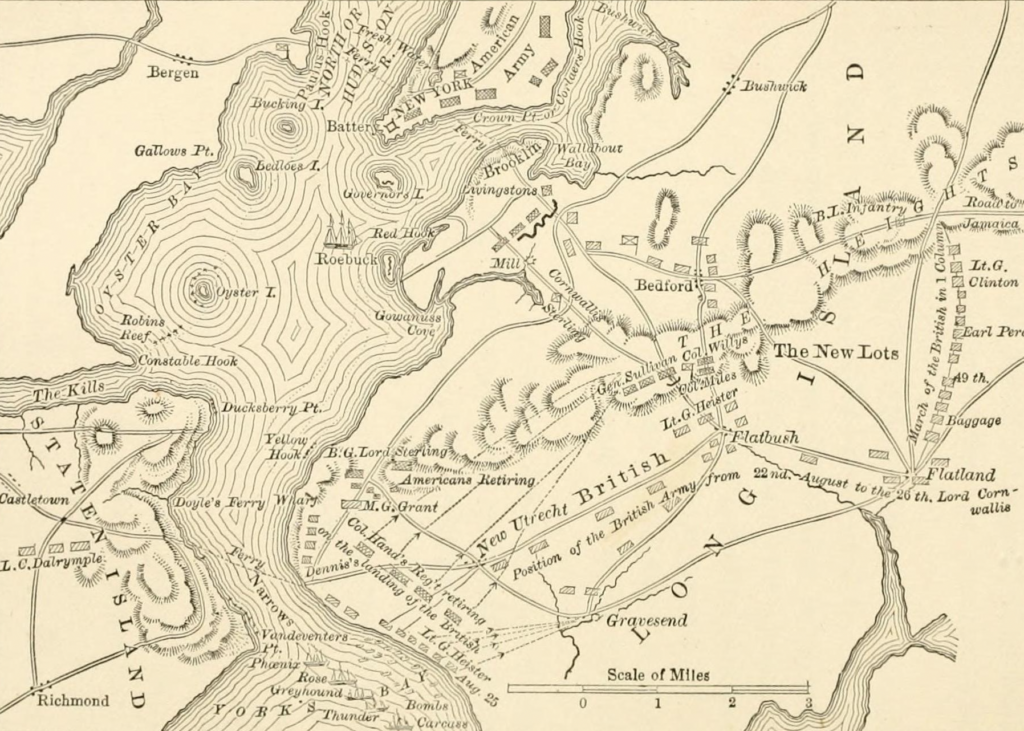
A general view of the Battle of Long Island. The invasion force was still centered in lower Brooklyn on August 22nd, with reinforcements, should they be needed, on Staten Island. Three days later an additional transport of Hessians would land near Gravesend. From The Hessians and the other German auxiliaries of Great Britain in the revolutionary war by Edward J. Lowell.
As night fell, some of the British and Hessian forces were within three miles of the main American line protecting Brooklyn Heights. Washington, writing to Connecticut Governor Jonathan Trumbull and asking for much-needed reinforcements, admitted that he was still not able to determine “what the real designs of the enemy are.” An estimated 1,800 Americans, camped among the trees of the heights, faced the much larger force, carefully watching their enemies across the broad plains below. The next few days would be marked by skirmishing, residents, Patriots and Loyalists alike, fleeing from their homes to the respective lines, and the looming realization that the expected battle was quickly approaching.