Following the invasion of Brooklyn by the British and Hessian soldiers on Thursday, August 22nd, it was readily apparent that a general engagement would soon begin. With General Howe headquartered in New Utrecht, General Cornwallis and the Hessian troops camped out on the broad plains of Flatbush, and troops spread out from Gravesend to Flatlands, they faced lines of Americans camped out in the “Woody Heights.” Also known as the Heights of Guan, these formed the outer defenses of the Continental Army. The lines were spread over four miles, and as the night descended the forces warily eyed each other’s campfires.
August 23rd (Friday)
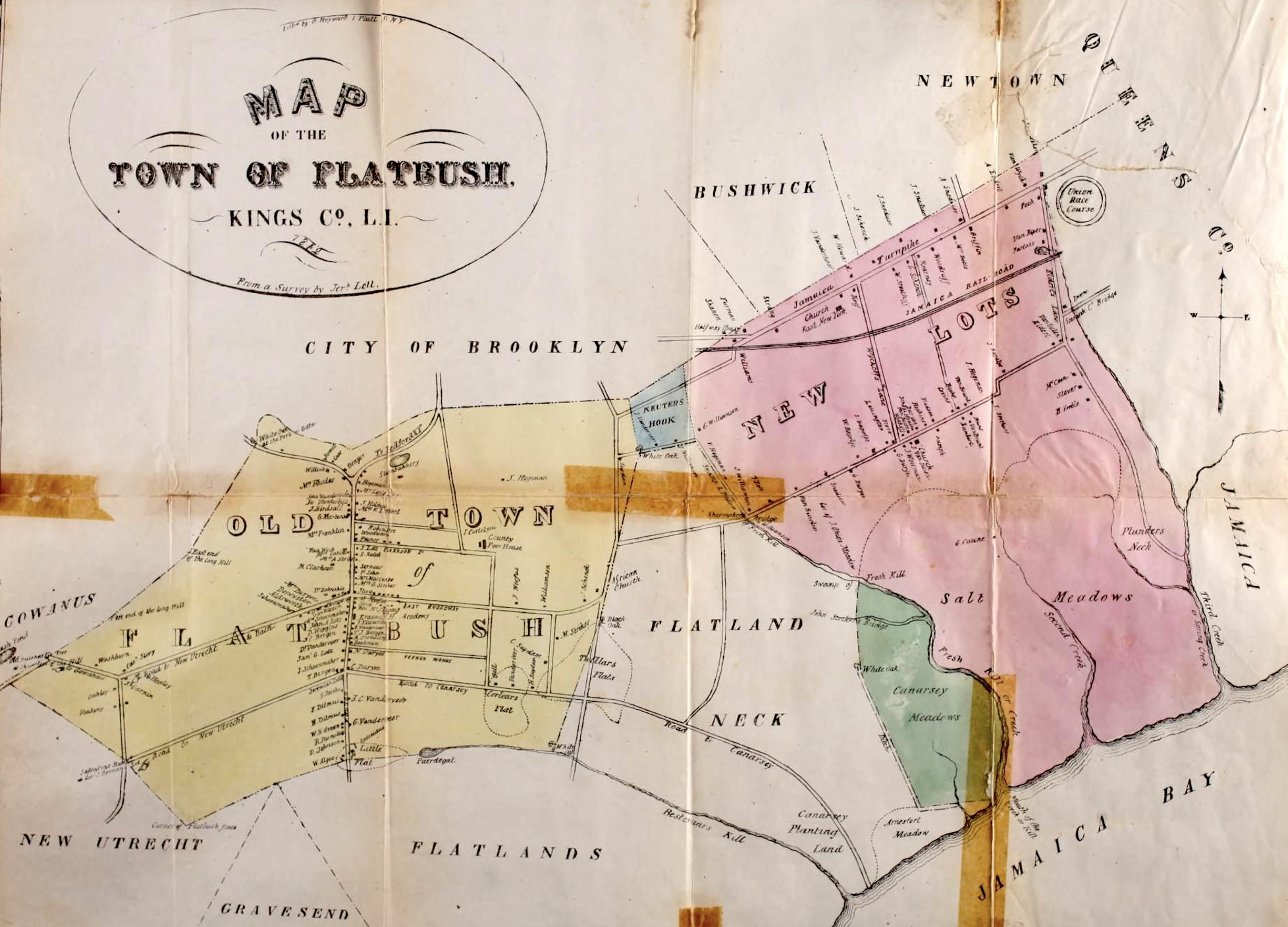
A map of the Village of Flatbush, showing its relationship to the new lots that had been purchased, distinguished from the old lots of the village. New Lots became its own town in 1852. From The History of the Town of Flatbush in Kings County, Long-Island by Thomas M. Strong.
On the morning of the 23rd, several small skirmishes broke out near Flatbush, with a detachment of riflemen firing upon the Hessians camped in the village. The Americans had built a semicircular entrenchment guarding the Flatbush Road, and just to the north a small redoubt had been built on a hill. The roadbed had trees piled up in it to delay the advance of the enemy, including the venerable “Dongan Oak,” a massive white oak tree which had once marked the boundary between Brooklyn and Flatbush.
The woods along the Heights of Guan provided convenient cover for the Americans, who periodically fired upon the Hessians before being repulsed by cannon fire. Regrouping that afternoon, they brought up cannon of their own, which was set up near the Vanderbilt houses, and made their way towards the Flatbush Church. There they exchanged fire with the Hessians and British, who ducked into empty houses and buildings to take cover. The fight continued for around an hour before the enemy pushed the Americans back.
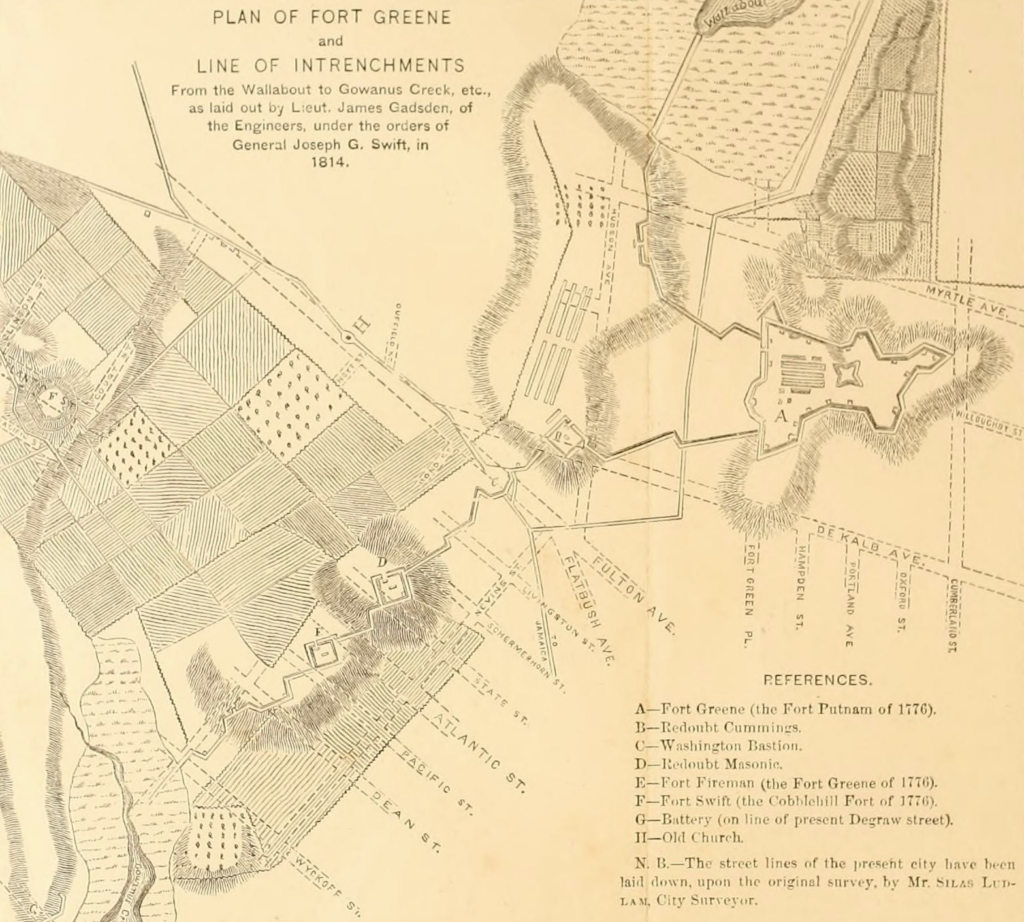
A plan of Fort Greene (Fort Putnam in 1776), showing the rough line of forts protecting Brooklyn Neck. After the battle, the British took over the forts and strengthened them, and they were again bolstered in anticipation of a possible invasion during the War of 1812. From A History of the City of Brooklyn by Henry R. Stiles.
Washington, still concerned that the British would launch an attack on New-York, mulled over the next course of action while preparing the troops for the inevitable. At the time, he grossly underestimated the British force, thinking that it was “said to be Eight or Nine thousand” troops. However, he issued orders to have five days of bread baked, notifying the officers that the soldiers should all have 24 cartridges and 2 flints, and doing his duty to rally the spirits of the men, reminding them that “the hour is fast approaching, on which the Honor and Success of this army, and the safety of our bleeding Country depend.”
The same day, General Howe issued a proclamation aimed towards Loyalists in and around the area, giving notice to “all persons so forced into rebellion” that “ all those who choose to take up arms for the restoration of order and good government within this Island, shall be disposed of in the best manner, and have every encouragement that can be expected.” While some militiamen had joined with the British on Staten Island, and the spy network was robust enough to feed them crucial intelligence about the roads and troop movements, many people had fled their houses and farms in the days preceding the invasion, so perhaps fewer than expected joined up with the British.
August 24th (Saturday)
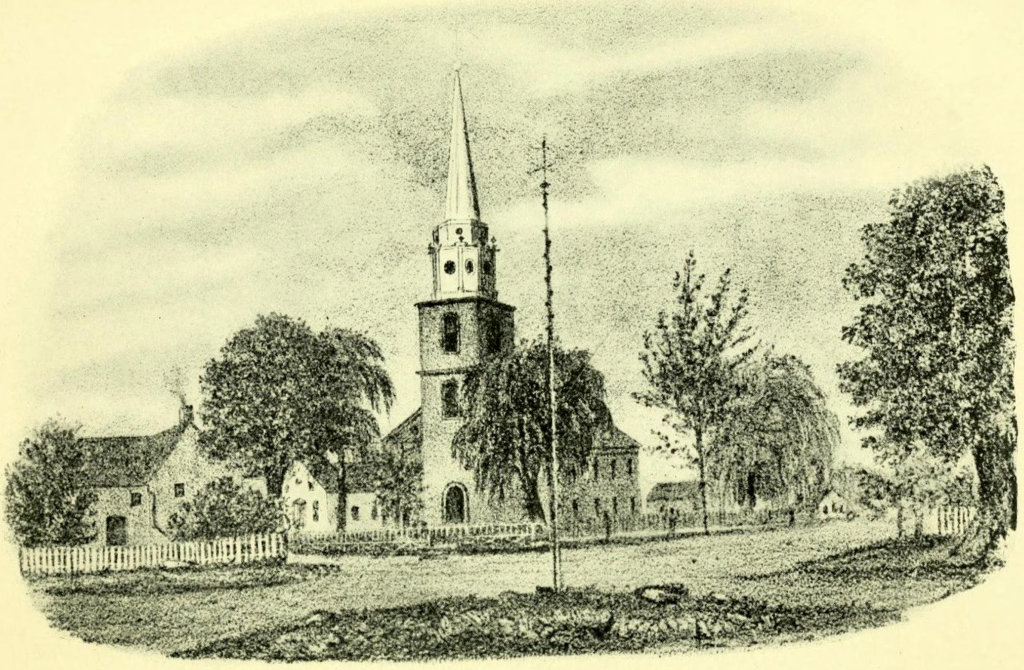
The Flatbush Church, seen in 1842. On the left is the Neefus House, on the right is the Zabriskie House, and the road going from left to right is Church Avenue, where it intersects Fulton Street. The church was used as a hospital after the Battle of Brooklyn, and some casualties were buried under it. From The History of the Town of Flatbush in Kings County, Long-Island by Thomas M. Strong.
As another day dawned, the attacks upon the enemy camp at Flatbush were renewed, and cannon fire was heard and smoke seen by soldiers on the inner line of defenses protecting Brooklyn Heights. At one point, the Americans set fire to several buildings in Flatbush village. A Hessian observing the fighting remarked that the Americans “have some very good marksmen” who skillfully climbed trees and demonstrated the wiles of a hunter, even though they lacked quality guns. However, Washington thought that the skirmishing wasted ammunition and was the “kind of fire that tended to disgrace our own men as soldiers.”
General Sullivan took the time to thank the “brave officers and soldiers who with so much spirit and intrepidity repulsed the enemy and defeated their designs of taking possession of the woods near our lines.” In the morning, Washington crossed over to meet with him and observe the lines. What he found was discouraging, as some of the inner works were still unfinished. He sent four additional regiments across to support the troops guarding the passes and inner lines, and appointed General Israel Putnam as commander, with instructions that Putnam “form a proper line of defence round your encampment and works.”
August 25th (Sunday)
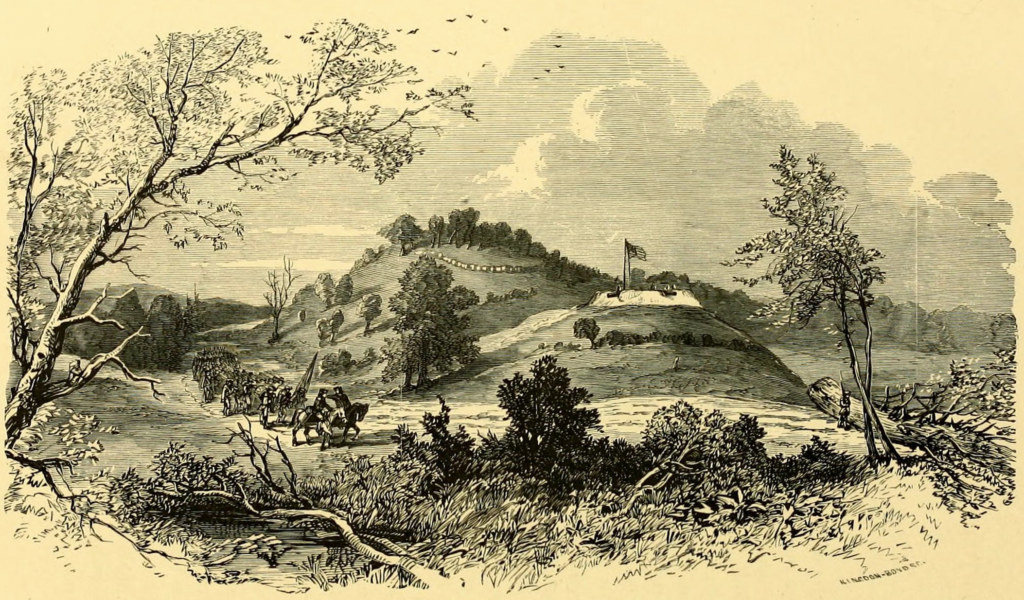
The redoubt overlooking the Flatbush Road, shown as it appeared shortly before the Battle of Brooklyn. The area was later called Valley Grove (a name that doesn’t seem to be contemporary), and a tavern was later built here. From Historic and Antiquarian Scenes in Brooklyn and its Vicinity by Thomas W. Field.
General Sullivan’s orders for the day were for 800 troops to be stationed at the Gowanus Pass, Flatbush Pass, and Bedford Passes, along with pickets of around 100 men ahead of each. He warned the troops to stay along their lines, as “the enemy are hourly expected to make an attack.” General Putnam was busy overseeing the construction of reinforcements on the inner lines, which had nearly double the number of men within them compared to the outer defenses. These were angled away from the former and followed the line of the high ground.
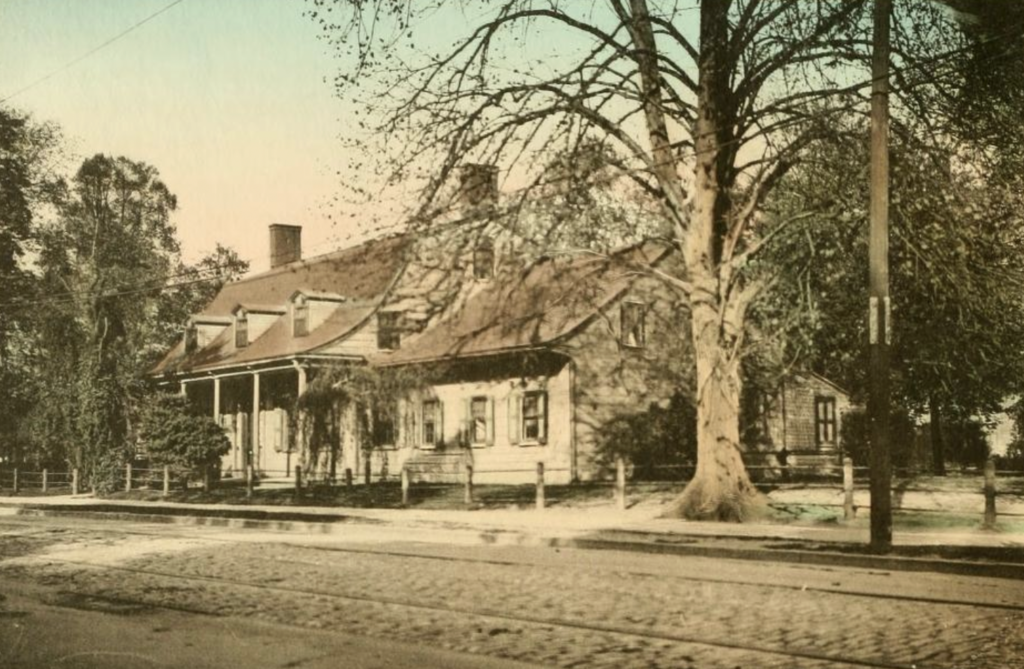
The Lefferts Homestead, 1909. The earlier house was burned down in 1776 in the lead-up to the Battle of Brooklyn. The homestead, rebuilt after the war by enslaved laborers, was later moved to Prospect Park, where it sits today. From Historic Homesteads of Kings County by Charles Andrew Ditmas.
Much to the dismay of the Americans, another 4,000 Hessians under Generals Leopold de Heister and Wilhelm von Knyphausen landed near Gravesend and marched towards Flatbush. This brought the totals to around 20,000 British and Hessians against fewer than 10,000 Americans. General Howe, receiving reports about the American troop movements and with guidance from officers such as General Henry Clinton who knew the land well, thought that he could take the chance by organizing a daring march through the fourth of the main passes, which was only guarded by a handful of men.