
A map of Tottenville and some of its notable features, including Burial Ridge. This area is the site of the largest known Native burial ground in the city. The Billopp House is towards the bottom. From Staten Island Names, Ye Olde Names and Nicknames by the Natural Science Association of Staten Island.
With the overwhelming victory at the Battle of Brooklyn, brothers General William Howe and Admiral Richard Howe were in a particularly interesting position, as the men who brought war to the shores of Brooklyn had in fact been appointed by King George III as peace commissioners. However, this appointment carried with it numerous restrictions, against which the Howes chafed, with General Howe referring to the “very limited commission and instructions.” They could pardon certain rebellious colonists should they desire to do so (besides those on the blacklist, which included John Adams), but did not have the authority to negotiate a peace treaty.

The British fleet off of Staten Island in July, 1776. Drawn by Archibald Robertson. From Iconography of the City of New York, Volume VI by I.N. Phelps Stokes.
The Americans were rightfully wary of this appointment and their intentions. Indeed, earlier in the summer Lord Howe had failed to append the correct military rank on a letter to George Washington, referring to him as “George Washington, Esq.” and not General Washington. Washington refused the letter but several days he Washington agreed to a meeting with Lieutenant Colonel James Patterson, Howe’s Adjutant General. Patterson spoke of the Howe’s great powers and desire to “accommodate this unhappy dispute,” to which Washington replied, knowing the limitations of the Howes as peace commissioners, that “those who had committed no fault wanted no pardons.”

The Howe Brothers. Admiral Richard Howe is on the left, and General William Howe is on the right. From The Command of the Howe Brothers During the American Revolution by Troyer Steele Anderson.
However, in the aftermath of the battle, the Howes saw an opening. General John Sullivan, who had been captured at the Battle of Brooklyn, was paroled, and travelled to Philadelphia to ask the Continental Congress to arrange a meeting. Sullivan had told General Howe that the Americans knew that the brothers could only issue pardons and proclaim peace. Mulling this over, they chose to ask for the conference to be carried out between “private gentlemen,” instead of them meeting in their official capacities.

The American delegation: Benjamin Franklin, Edward Rutledge, and John Adams. The trio conveniently represented three distinct geographic regions, which likely factored into their selection. From The Conference or Billopp House, Staten Island, New York by William T. Davis.
After considerable deliberation, Congress resolved that it would not be appropriate to send their members in a private capacity, but that they could “send a committee of their body to know whether he [General Howe] has any authority to treat with persons authorized by Congress for that purpose.” They held an election, selecting Benjamin Franklin, Edward Rutledge, and John Adams. Adams had vocally opposed the meeting, calling Sullivan a “decoy duck.” However, he dutifully went with the others, who left Philadelphia on September 9th. Adams recounts a humorous account of sharing a bed with Franklin in Brunswick, where they bickered about keeping the window open, and Franklin lectured Adams at great length on the benefits of cold air, which helped him fall asleep.

The Billopp House in 1898. Built by Captain Christopher Billopp c. 1680, it was the centerpiece of a sprawling estate, which the family called “Bentley Manor.” From The Conference or Billopp house, Staten Island, New York by William T. Davis.

A view from the front porch of the Billopp House towards the Arthur Kill and Perth Amboy beyond. From the Annual Report of the American Scenic and Historic Preservation Society to the Legislature of the State of New York v. 8, 1903.
Admiral Howe had his headquarters at the Billopp House in Tottenville, where the parties met on September 11th. Christopher Billopp was a Loyalist who fought for the British, with several raids carried out from Billopp Manor during the course of the war. The Americans were taken over the Arthur Kill on a barge, bringing back with them a British soldier who had been appointed as a hostage, as all agreed that they did not need this assurance as a pledge. They were greeted by Howe on the beach, and despite the squalor of the Billopp house, which had been used as a military barracks, and which Adams described as “dirty as a stable,” the staff had spread out moss and hung up sprigs to make it more pleasant. Joined by Howe’s secretary, the men dined on a cold dinner of bread, ham, tongue, and mutton, accompanied by claret.
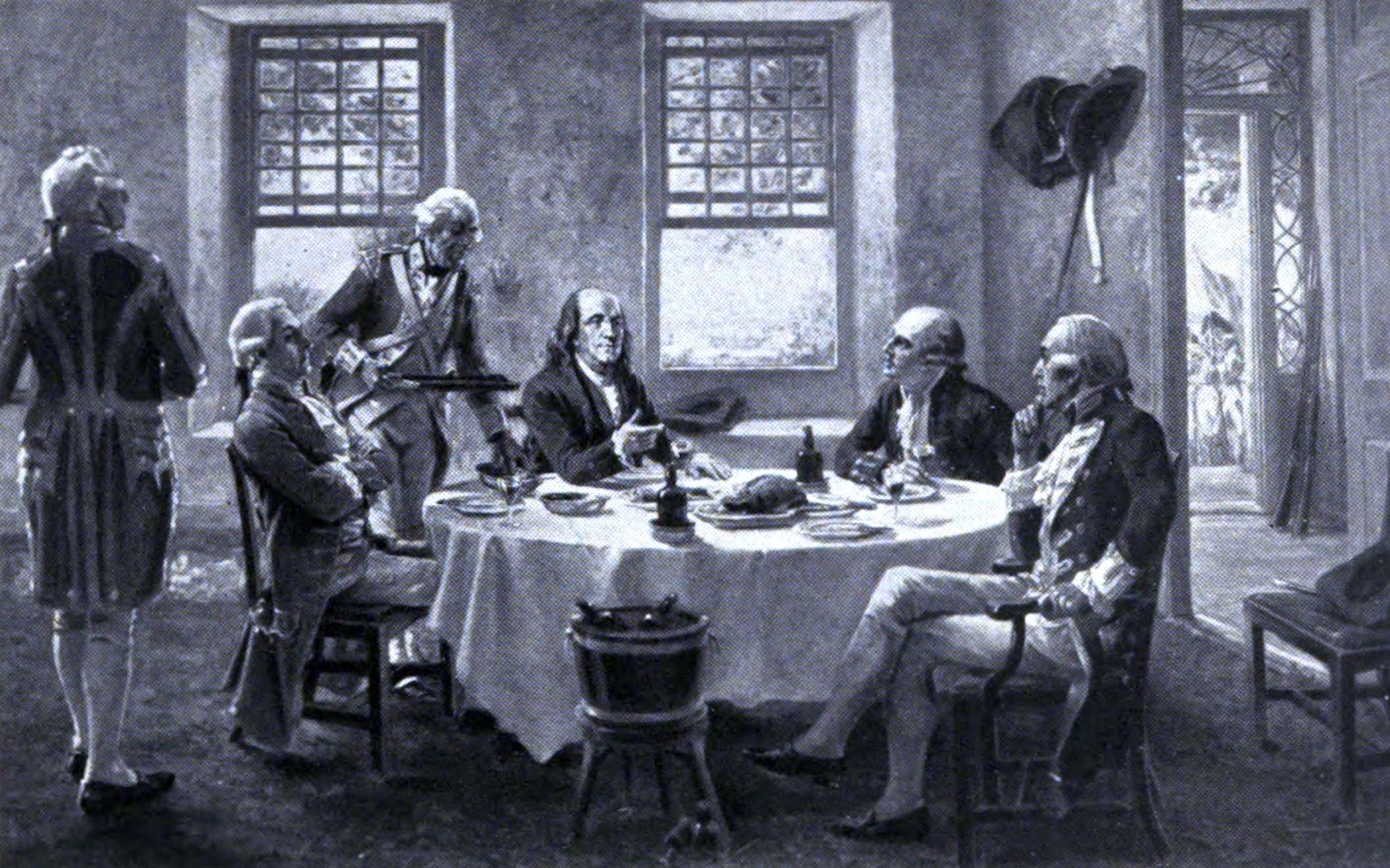
A depiction of the peace conference, showing Benjamin Franklin speaking to the group. Howe and Franklin had met in 1774 and corresponded in the lead up to and early days of the war. From Early days of the island of Manhattan and its environs, 1626-1776 by the Title Guarantee and Trust Co., 1927.
Howe opened the meeting, noting that although he was a “Well Wisher to America” (particularly Massachusetts, who had contributed funds for a monument to his late brother in Westminster Abbey), he “had not, nor did he expect ever to have, Powers to consider the Colonies in the light of Independent States.” Answering another of the questions that the Americans had, he noted that he could not “confer with these Gentlemen as a Committee of the Congress,” to which Franklin replied that “the Conversation might be held as amongst friends,” with the assent of Adams and Rutledge. Howe tried in vain to argue that “His Majesty’s most earnest desire was to make his American Subjects happy” and that he would address their grievances if they gave up the idea of independence.

Another depiction of the conference, by Alonzo Chappel. From The Conference or Billopp House, Staten Island, New York by William T. Davis.
According to Adams, Howe’s discourse “contained no explicit proposition of Peace, except one, namely, That the Colonies should return to their Allegiance and Obedience to the Government of Great Britain.” Franklin replied to Howe that “all former Attachment was obliterated, that America could not return again to the Domination of Great Britain,” and Rutledge agreed that “it was impossible the People should consent to come again under the English Government.” Since Howe could not recognize the representatives as members of Congress (and not merely private gentlemen), nor enter into any negotiations if “the Colonies would not give up the System of Independency,” the conference, which had lasted around three hours in total, came to an end.