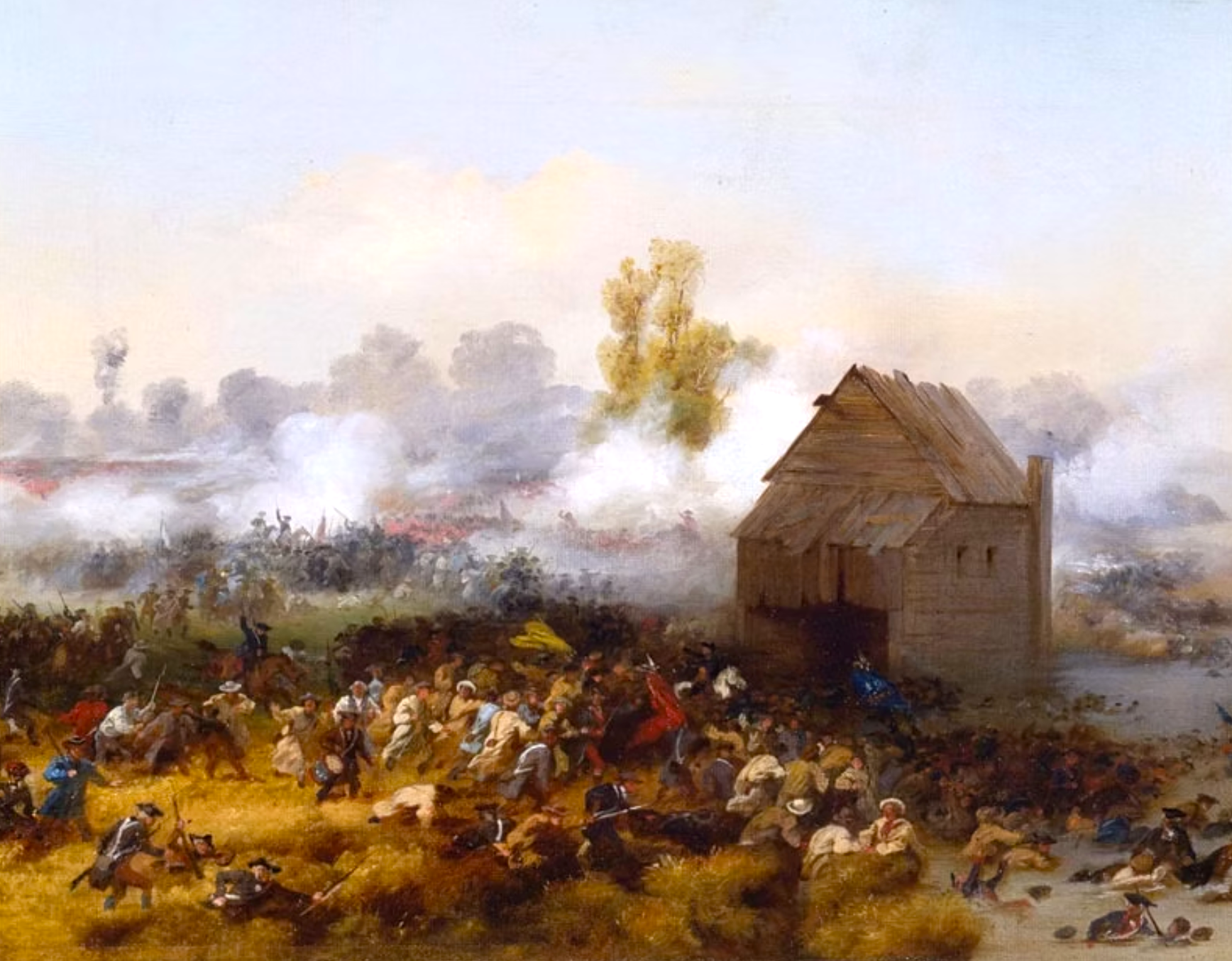
The American retreat across the Gowanus Creek following their last valiant charge at the Vechte-Cortelyou House. After a painting by Alonzo Chappell. From The Eagle and Brooklyn, The Record of the Progress of the Brooklyn Daily Eagle.
August 26th
The morning of August 26th saw Washington crossing back over to Long Island to continue readying the lines. His orders report that he was “very anxious for the state of the arms and ammunition…” and “earnestly enjoins officers and men to be particularly attentive to it and have them in the best order.” Late in the day, he rode out with his generals to view the enemy on the Flatbush plains, and ordered additional reinforcements, including regiments of Marylanders.
General Howe had solidified his plan of attack, and planned a feint to draw the Americans into battle while the bulk of his forces marched towards Jamaica and the pass through the heights. General Henry Clinton, who knew the area, had reconnoitered the passes, and passed his intelligence on to Howe, was appointed to lead the vanguard. In order to cover the movements and free up General Charles Cornwallis to move down to Flatlands and meet up for the flanking march, General De Heister took command of the troops in Flatbush. General James Grant was ordered towards the Gowanus Pass along Martense Lane, which was the easternmost pass and closest to the water.
Around 800 Americans were posted at each of the passes, guarding, from west to east, the roads through the Gowanus Pass, Flatbush Pass, and Bedford Pass. On the left flank, Colonel Samuel Miles and Lieutenant Colonel Daniel Brodhead were posted just beyond the Bedford Pass, forming the easternmost line of defense, with around 500 men. A vidette of five horsemen, dispatched by General Sullivan, and supposedly paid by him, were the only resistance posted at the Jamaica Pass.
Cautious of the movements on their right and center, the Americans knew that this suggested that a general engagement would soon be upon them, although the bulk of the army was encamped behind the fortifications on Brooklyn Heights. However, even at this late hour, Washington, writing to General Heath that “the present appearance of things seems to indicate an intention in the enemy to make their capital impression on the side of Long Island,” was still worried about an attack on New-York. The anxious general returned to York Island just as the British began their night march.
9 PM to 10 PM
With Generals De Heister and Grant in place, their men left tents in place, maintained the sounds of the camp, and stoked fires to help camouflage the movement of the larger body. With the light infantry ahead of the main column to gather up anyone in the way, the men proceeded slowly through fields, so as to muffle their boots and not give their position away. Secrecy was paramount, as the column, including an estimated 10,000 men, plus their baggage and 14 field pieces, stretched for over two miles. It would take six hours for the rear guard to reach the intended target.
11 PM to Midnight
Around 11 o’clock, an advanced party of British scouts moving east along the Martense Lane, stopped at a watermelon patch. As they were rummaging around, the troops posted by the nearby Red Lion Tavern spotted them, and fired their guns on the scouts, who fled. The popular tavern stood where the Martense Lane joined the Gowanus Road (approximately around 35th Street near 4th Avenue). The tavern had been guarded since the invasion on the 22nd, and 120 men under Colonels Atlee and Kichline were watching out for the expected attack from the British.
August 27th
1 AM to 2 AM
Another British column proceeded up the Narrows Road, approaching the Red Lion Tavern from the west. American pickets fired upon them, and a small skirmish erupted. General Parsons quickly organized the disparate bands, which formed enough of a resistance to stop the British from advancing for the time being.
2 AM to 3 AM
The flanking column winding their way towards the Jamaica Pass had proceeded slowly, cautioned by their Loyalist guides that the Americans could be guarding the route, posted in the thick woods and poised to attack. However, this was not the case, and once the vanguard reached Schoonmaker’s Bridge, it was clear that the way to Jamaica would be clear. By 2 o’clock, they had reached Howard’s Half-Way House (also known as the Rising Sun Tavern), and waited for the wagons to pass on their way to the market.
The tavern’s proprietor and his son were taken prisoner and forced to lead a small group around the Rockaway Path to the Jamaica Pass. A patrol under General Clinton captured the American vidette, and Clinton interrogated them, discovering that the pass was not guarded. He sent the light brigade to occupy the heights, and once this was accomplished, the men paused to rest and breakfast, while the remainder of the column moved through the pass.
3 AM to 4 AM
Around 3 o’clock, General Stirling, who was headquartered at the Vechte-Cortelyou House, was informed that a larger enemy force was coming, and began to make his way down the Gowanus Road, accompanied by the Marylanders and Delawareans, and followed by General Parsons and Connecticut and Pennsylvania troops. The British advanced slowly, making their way across the low-lying, swampy land, but eventually drove the Americans back.
4 AM to 5 AM
During this hour, Putnam notified Sullivan that fighting had broken out to the west, and the men were roused to their posts. The Hessians had been firing cannon towards the Flatbush Pass. The Americans had constructed abatis and breastworks to protect the road, and even felled the venerable Dongan Oak, which had once served as a boundary marker between Brooklyn and Flatbush. On the hill to the west of the pass, they had constructed a small redoubt, which was protected by 400 men, with riflemen posted in the nearby woods.
5 AM to 7 AM
Stirling received two field pieces, which were used to great effect on the British, who fired back with their four pieces. General Grant sent men forward at intervals. The troops continued skirmishing, as the main objective for the Americans was to hold the line, as they believed that this was the main British attack. The right of the American line rested on Blockje’s Bergh, a cliff overlooking Gowanus Bay that offered a commanding view of the road and easily allowed the Americans to unleash fire upon the British.
7 AM to 8 AM
At Flatbush, the Hessian cannonading increased in ferocity as they prepared to advance on the Flatbush Pass. Colonel von Donop, commanding the Hessian jagers, moved forward to pick off the American riflemen in the woods. Some of them carried carbines, which proved to be much more effective in the woods than the longer muskets the Americans carried.
On the right flank of the Americans, the fight around the Gowanus Road and between the hills, the western of which would be immortalized as Battle Hill, continued in earnest. The British approached a small bridge near Blockje’s Bergh, which was flanked by hedges and orchards, which the troops used for cover as they fired upon the Americans. Some of the Americans under Colonel Atlee posted on top of a hill overlooking the road below, which would form the left flank of the American defenses. This would prove to be a particularly advantageous position for the Americans. Their defense held, and for the time being it looked like they were keeping the main force of the British at bay.
8 AM to 9 AM
Around 8 o’clock, Sullivan, hearing the firing to his east, sent reinforcements to Stirling. The intelligence was that this was the main attack of the day. The Hessians were continuing to harass the American redoubt and the soldiers in the woods, but no one had heard from the small force posted to the west, nor from the vidette at the Jamaica Pass. Colonel Miles, who had supposedly voiced his opinion the previous night that the British would take the Jamaica Pass, had stumbled upon the baggage train and sent out a messenger that the British were coming down the Jamaica Road, but realized that he couldn’t attack the train with such a small force. Panicking, his men started to retreat.
The flanking column had reached the town of Bedford by 8:30, the culmination of nine miles of marching around the American lines. The British had succeeded with placing themselves in an excellent position, encircling the Americans without being detected by many. They announced their arrival with beating drums, blaring horns, and the clatter of muskets as they hurried towards the enemy. This would very nearly be the undoing of the entire American army.
9 AM to 10 AM
At 9 o’clock, signal guns rang out, notifying Generals Grant and De Heister that the flanking was complete. With this, the Hessians attacked the Flatbush Pass. The Americans had heard horrific stories about the fierce auxiliary troops, and how they would take no quarter. The Hessians in turn had been told the same by the British, and attacked the Americans with a particular ferocity. As Colonel von Heeringen sneeringly wrote of the Americans, it “takes them a quarter of an hour to load, and meanwhile they feel our balls and bayonets.” It took a single bayonet charge for the Hessians to clear the Flatbush Pass, and they drove the Americans up the Porte Road (above the pass the Flatbush Road split into two, with the western arm leading towards Brooklyn Heights and the inner American lines; the eastern arm, the Clove Road, lead to Newtown) towards Gowanus.
General Sullivan quickly realized that he was surrounded, and his troops fled in a chaotic retreat, joined by men under Miles and Brodhead, who had already passed through miles of woods in an attempt to escape. Some riflemen made a stand, using the woods for cover, and mowed down the British, while others, scrambling up Mount Prospect, found themselves facing Hessians, who bayoneted them, or surrounded by British troops, who fired upon some and captured others. In the midst of this, Sullivan himself was captured, leaving his men to reach safety on their own accord.
General Washington is thought to have been ferried over to Brooklyn around 9 o’clock or so. Although his exact movements during the battle are largely unknown, he perhaps watched the scenes unfolding from Fort Putnam, located on a prominence overlooking the Wallabout Bay, and perhaps later from Ponkiesbergh (the Cobble Hill Fort), to get a better look at the American retreat.
10 AM to 11 AM
According to General Parsons, by 10 o’clock they were at risk of being completely surrounded, noting that “we had no notice of the retreat of the main body till it was too late for us to join them.” General Stirling and his troops still held against Grant, who was gearing up to press the Americans. The British had been reinforced by 2,000 additional marines that had landed at Bennett’s Cove, likely named after Weynant Bennett, whose house stood near Blockje’s Bergh.
With the full British strength nearing 7,000 troops, Grant proceeded up the Gowanus Road, and the situation became increasingly desperate for Stirling and his men. Stirling fell back along the road but was soon surrounded by both British and Hessians who had come up from the Flatbush Pass via the Porte Road. His men had already fought valiantly for many hours, and scores were peeling off towards the American lines.
11 AM to Noon
By 11 o’clock, it was clear that Stirling was surrounded. The British had taken control of the Vechte-Cortelyou house and stationed field pieces there, but Stirling came up with a plan to attempt to save the bulk of his men. He appointed a group of Marylanders under Major Mordecai Gist and Delawareans under Colonel John Haslet to provide much-needed cover. These 400 men, facing nearly 2,000 enemy troops, charged the British and Hessians swarming around the house, and when they were beaten back they charged again. Closing ranks with each charge, they continued to attack the enemy until, by the fifth or sixth charge, they were far too few in number and were overrun, with many of them being killed in the process. British General Charles Cornwallis later wrote that Stirling “fought like a wolf,” and so did his men.
Washington, watching this dreadful scene unfolding from the American forts, bemoaned “Good God! What brave fellows I must this day lose!” American troops were frantically trying to escape the clutches of the enemy. However, this was a particularly daunting task, as the marshy, swampy land surrounding the Gowanus Creek stood between them and safety. The main bridge across the Porte Road had been burned, along with two of the mills in the area, and many of them couldn’t swim. Men drowned in the creek, with others barely making it across. Some risked the wrath of the Hessians rather than take the plunge, and Stirling was captured, although he evaded the British and instead surrendered to General de Heister.