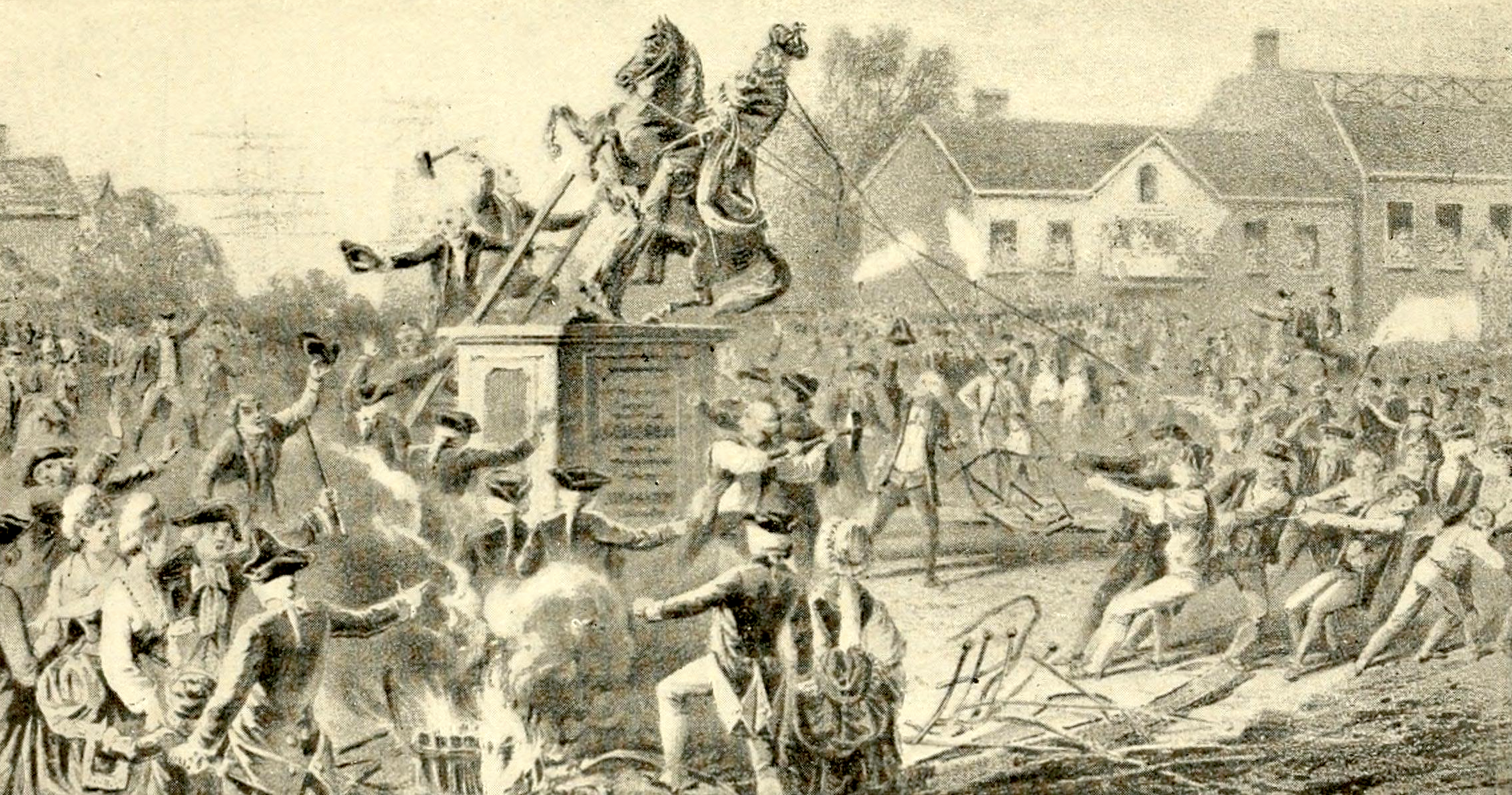
A group of angry New Yorkers tearing down the statue of King George III in Bowling Green on July 9th, 1776. This view is looking west towards Broadway, with the Archibald Kennedy House on the right, and Fort George on the left. From A Landmark History of New York by Albert Ulmann.
Although the concept of erecting a monument to a person was a novel one in the American colonies, a curious petition was circulated around one of the city’s coffee houses in June 1766. It expressed the desire to construct a brass statue to honor William Pitt the Elder. Pitt, despite helping to shape the course of the Seven Years’ War, after which the British government clamored for additional revenue sources to pay off their war debts, was greatly opposed to the Stamp Act, which was greatly detested in the American colonies.
Pitt saw this as a step too far, and earlier that year had given a spirited oration in Parliament demanding that it be repealed “absolutely, totally, and immediately.” The statue, which wound up being made of marble instead of brass, was placed at the corner of William and Wall Streets.
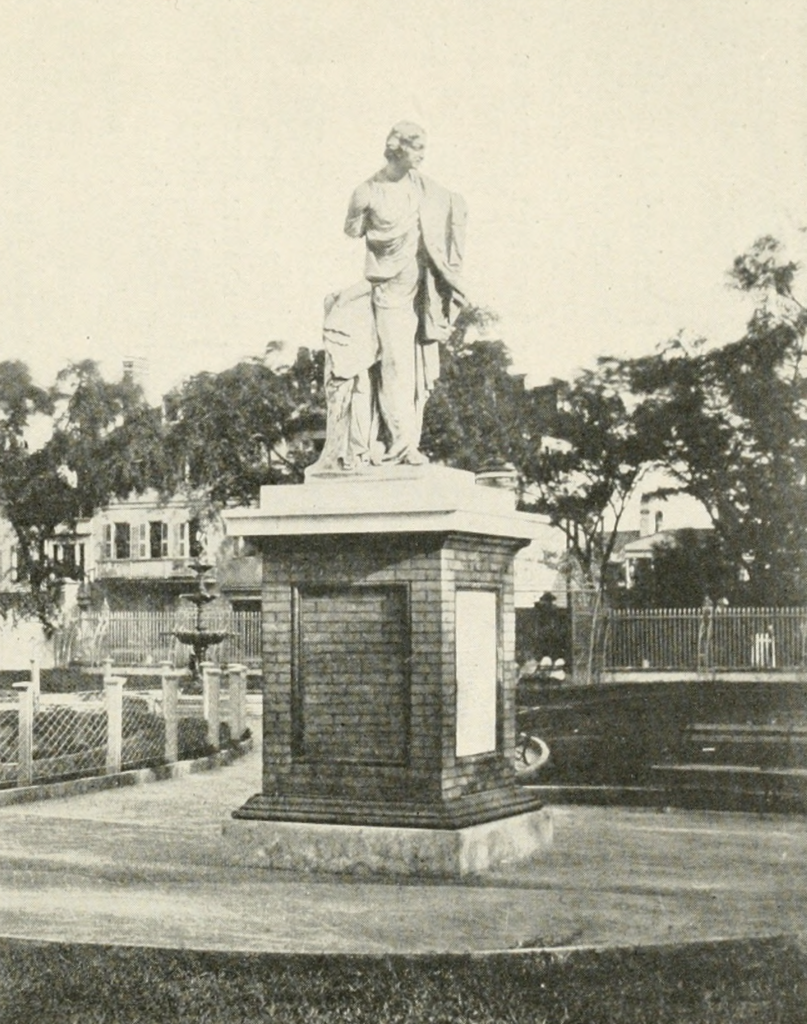
A similar monument to William Pitt the Elder in Charlestown, South Carolina (top). Completed in 1770, it was also sculpted by Wilton, and still stands, although not in its original location.
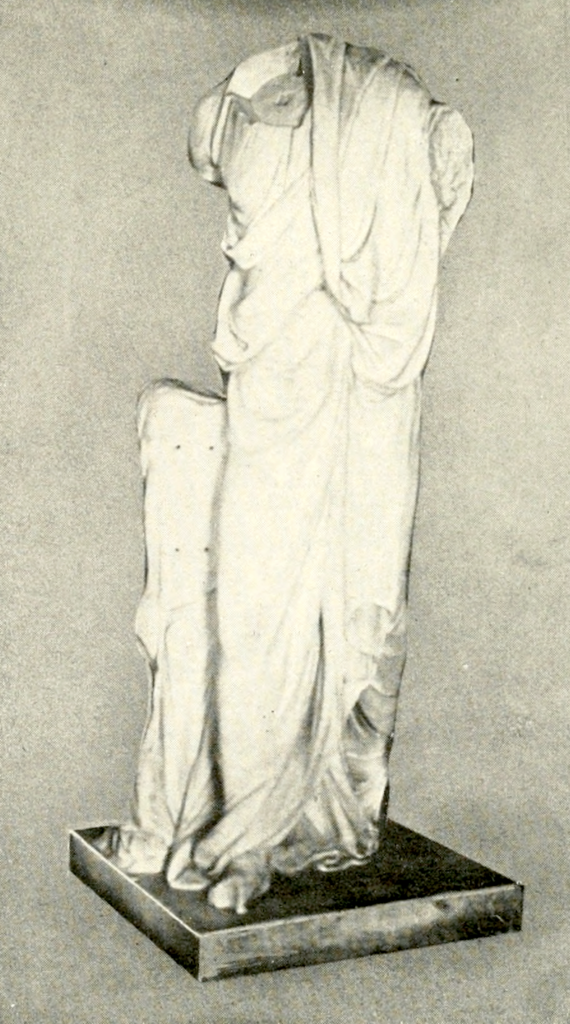
The remains of New York’s statue of William Pitt (below). It was vandalized by British soldiers who lopped off the statue’s head and badly damaged it. What remains is now in the collection of the New York Historical. Both from The Equestrian Statue of George III by Alexander James Wall.
Members of the General Assembly of the Colony of New York learned of this petition and, in a savvy political move, agreed that the statue should be erected, along with a larger monument to the king. They resolved to honor “our most gracious sovereign” and “to perpetuate to the latest posterity, the deep sense this colony has, of the eminent and singular blessings derived from him, during his most auspicious reign.” The Assembly authorized 1000 pounds for the statue.
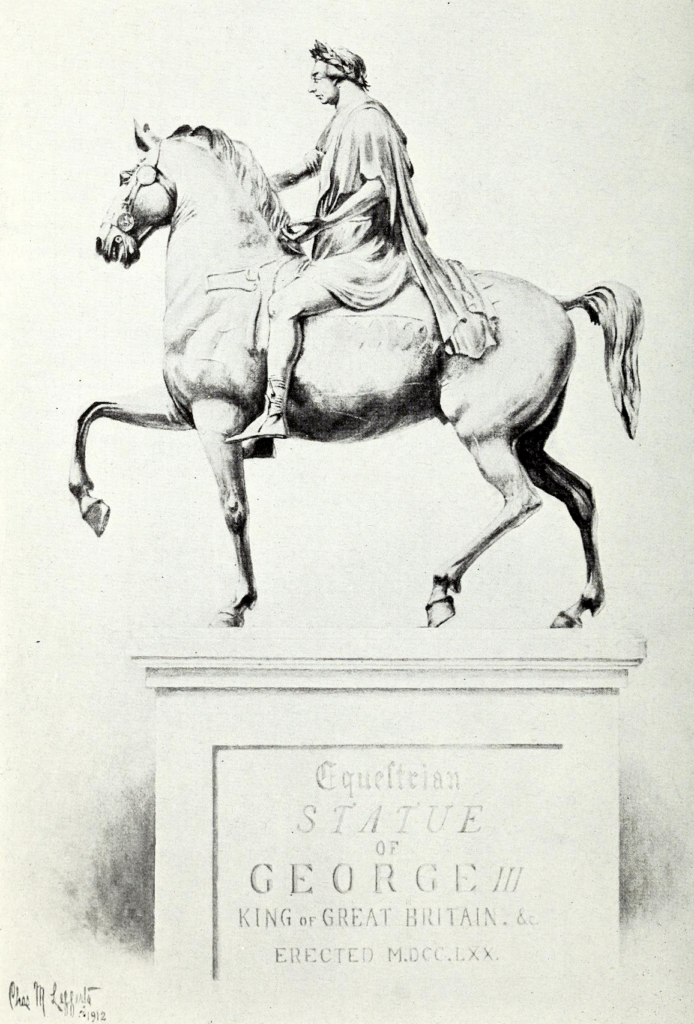
A reconstruction of what the statue of King George III may have originally looked like, drawn by Charles M. Lefferts. From The New York Historical Society Quarterly Bulletin, Volume IV, June 1920.
Sculpted by Joseph Wilton in London, the grand statue to the king was modeled on the equestrian statue of Marcus Aurelius that stood on the Capitoline Hill in Rome, complete with the king depicted with a great laurel wreath atop his head. Made of lead and gilt with gold, it was placed atop a massive white marble pedestal. Dedicated on August 16th, 1770, the occasion was attended by dignitaries who raised many toasts to the health of the king and, serenaded by musicians, examined the new statue. A 32-gun salute from nearby Fort George and a procession of soldiers rounded out the festivities.
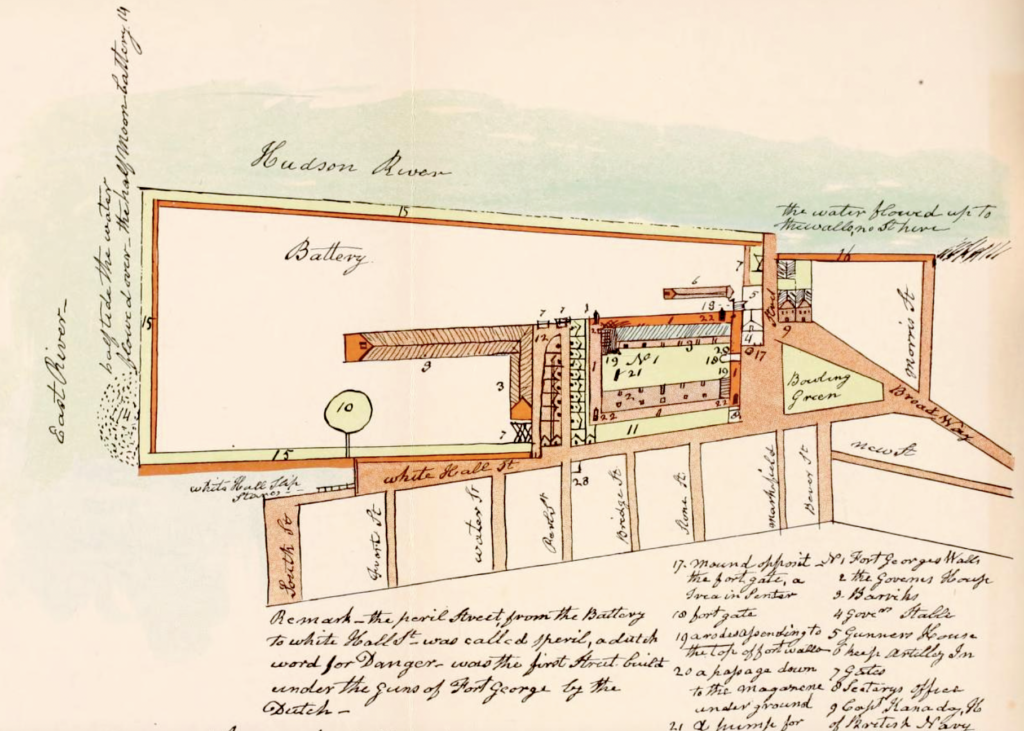
A sketch of the plan of Fort George and surrounding streets, c. 1776. Bowling Green is to the right in front of the north side of the fort. From The Iconography of the Battery and Castle Garden by William Loring Andrews.
Placed in a prominent position in Bowling Green at the bequest of the Common Council, it was not a popular monument for many New Yorkers, who saw it as a symbol of the crown’s continued tyranny and oppression. Not surprisingly, the statue was repeatedly vandalized with graffiti and had to be repaired. In 1771, the temporary rail fence surrounding the statue was replaced with an iron fence and stone foundation. The fence was topped with finials; according to many, these finials were shaped like royal crowns, although others have described them as closer to iron balls.
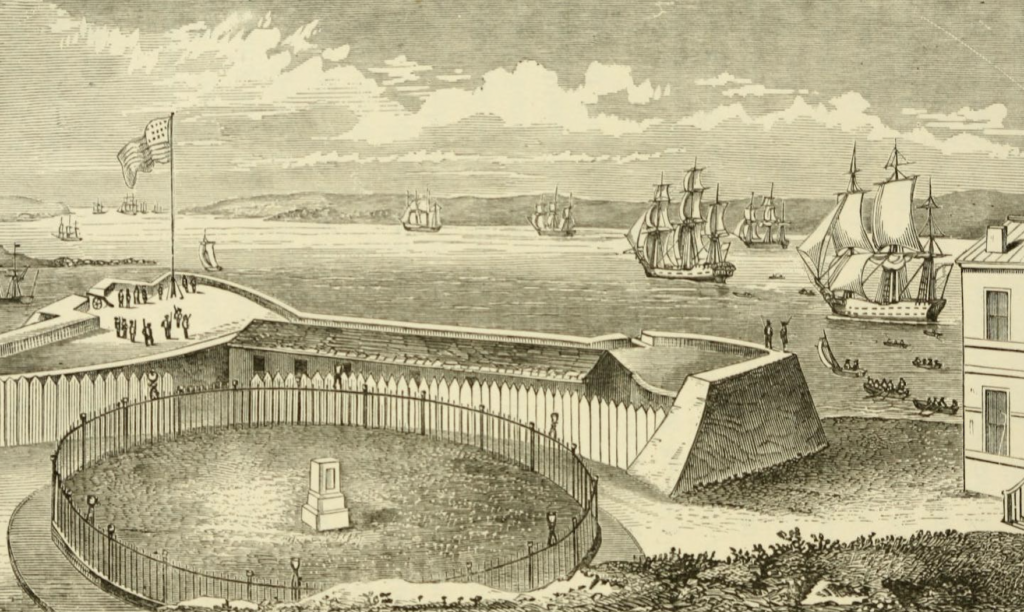
A sketch showing Bowling Green and Fort George as they looked during the British occupation, c. 1780. From History of the City of New York by Mary Booth.
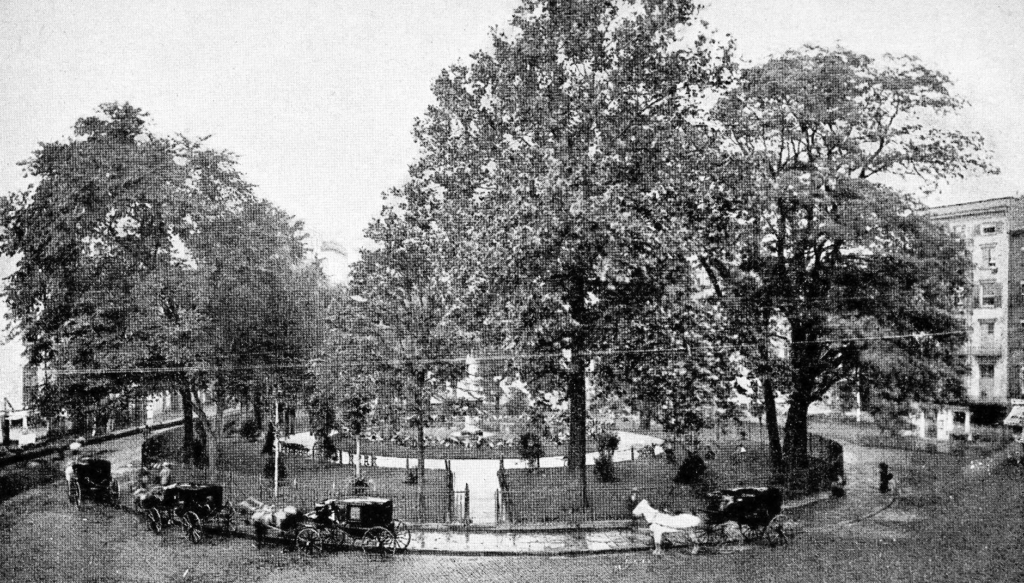
Bowling Green as it appeared c. 1869. This view is taken from what is now the location of the Alexander Hamilton U.S. Custom House. From Valentine’s Manual of the City of New York, edited by Henry Collins Brown, 1923.
On July 9th, 1776, the fourth New York Provincial Congress, meeting in White Plains, approved the Declaration of Independence. Its delegates to the Second Continental Congress had abstained from the July 2nd vote, as they had not been “empowered to give either an affirmative or negative voice.” However, on the 9th they were instructed to finally affix their signatures to the document. The Declaration had been printed in Philadelphia, and copies were taken to New York. The city was also in the midst of preparing for an expected attack, as the British had been gathering their ships off of the coast of Staten Island for several days.
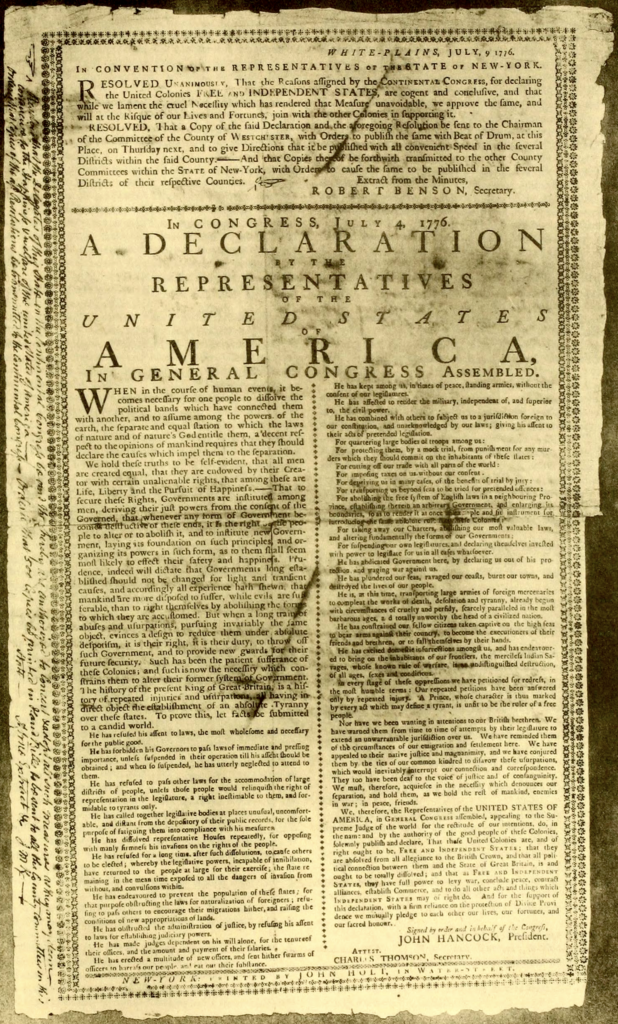
A broadside of the Declaration of Independence printed by John Holt. The New York Provincial Congress had him print 500 copies to be distributed across the city and state. From Iconography of the City of New York, Volume IV by I.N. Phelps Stokes, 1922.
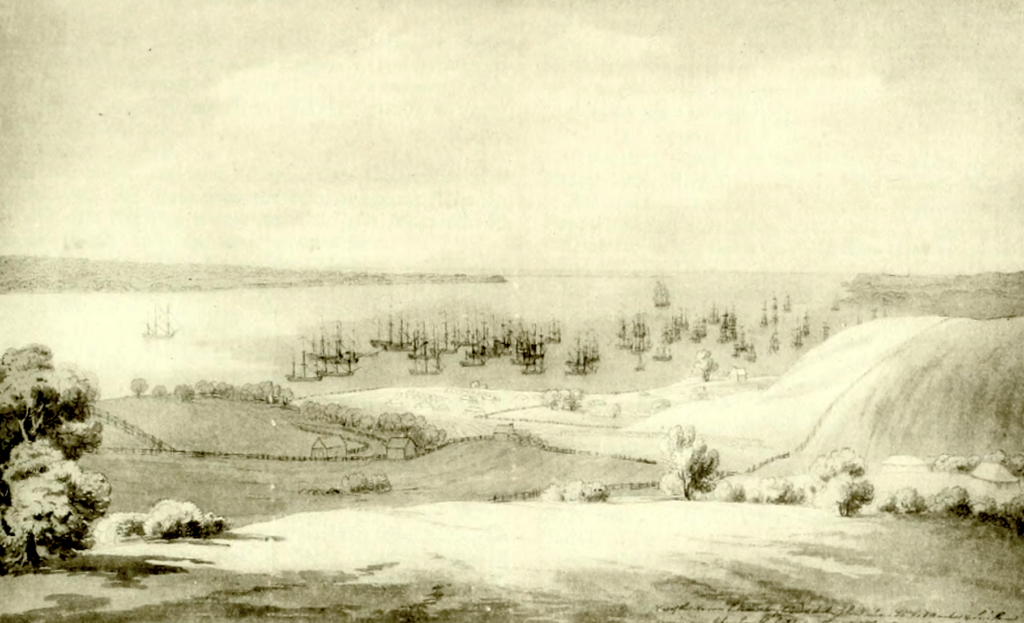
The British fleet gathering off the coast of Staten Island in July 1776. From Iconography of the City of New York, Volume VI by I.N. Phelps Stokes, 1928.
George Washington had been in the city since April, and thousands of Patriot troops were located in and around New York, constructing numerous fortifications under the eye of Rufus Putnam. A public reading of the Declaration had been held in Philadelphia on July 8th, and the next day Washington issued an order for troops to gather at 6 o’clock that evening for a reading of the document. Copies were also distributed to officers so they could be read to their men.
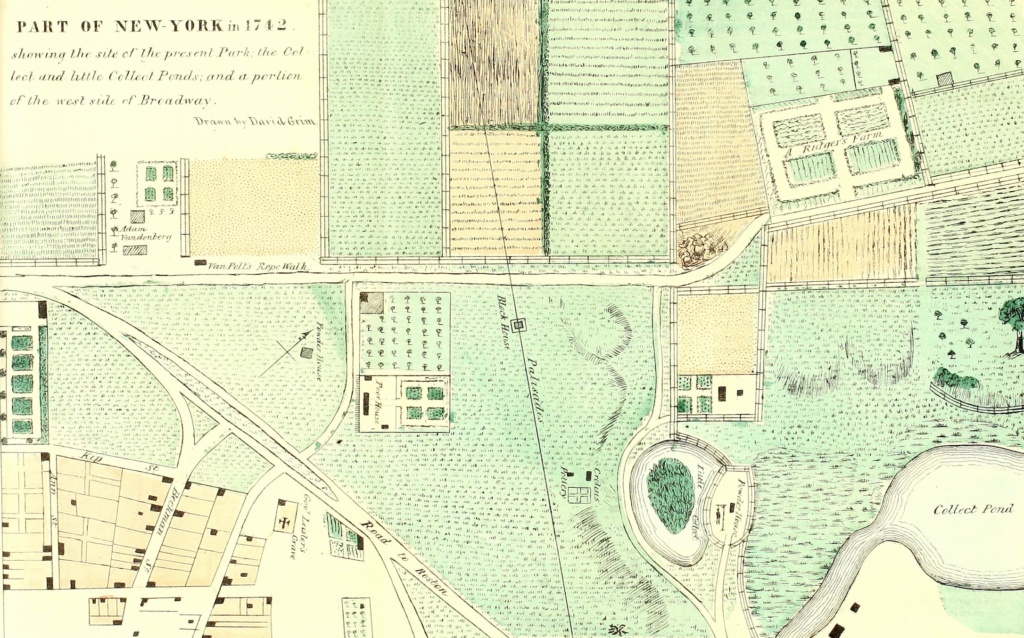
The city commons as it looked in 1742. In the middle is Broadway, with the old Eastern Post Road (later Chatham Road, and then Park Row) on the diagonal. From D.T. Valentine’s Manual of the Corporation of the City of New York, 1856.
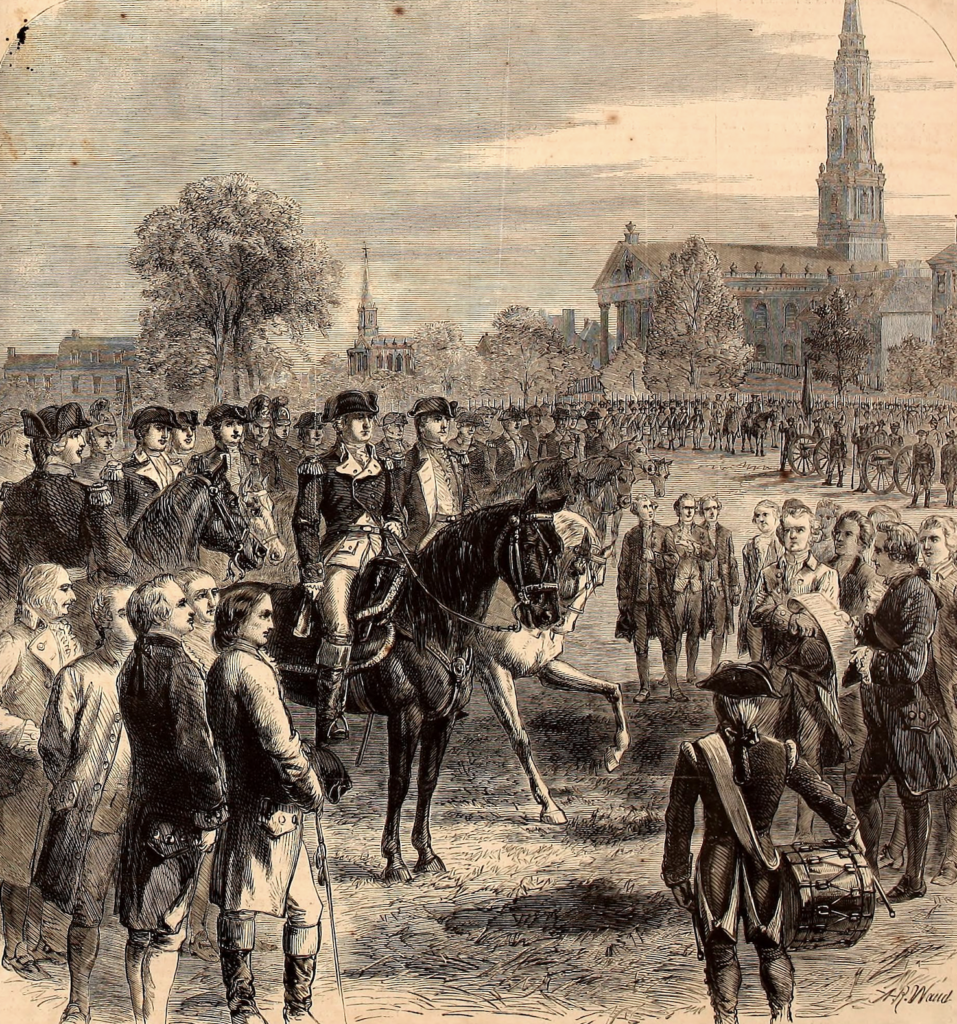
A drawing commemorating the 100th anniversary of the reading of the Declaration of Independence on the commons. To the right is St. Paul’s Chapel, and Trinity Church can be seen in the distance, marking the route of Broadway towards Bowling Green. From Harper’s Weekly, July 9, 1870.
At the appointed time, Washington met the troops on the public commons (where City Hall Park is now) and one of his aides-de-camp read the Declaration out loud. At the conclusion, the men cheered heartily three times and dispersed. Following this, after continuing the celebrations at select favorite taverns, some members of the Sons of Liberty led a raucous group down Broadway towards Bowling Green. Smashing in the locked gate, the crowd attached ropes to the statue, and pulled it off of its pedestal. Once brought to the ground it was quickly torn apart.
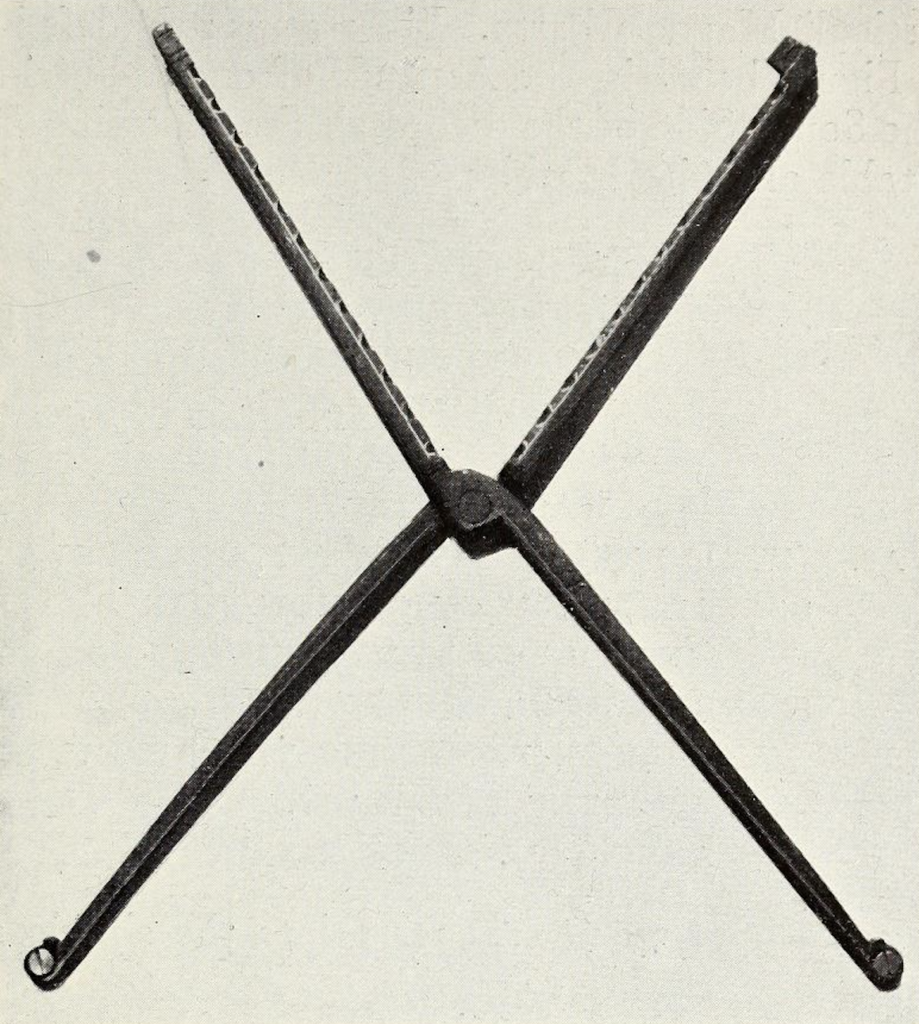
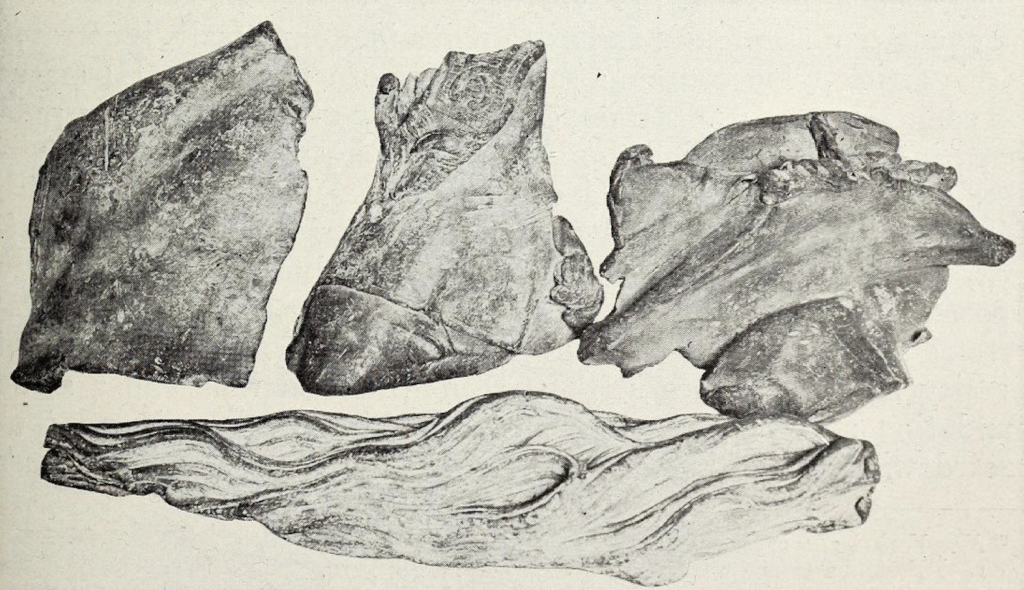
An example of a bullet mold used to make lead bullets (top). Some pieces of the statue that have been recovered over the years (bottom). These are in the collection of the New York Historical. Both from The New York Historical Society Quarterly Bulletin, Volume IV, June 1920.
Chunks of the statue, weighing an estimated 4,000 pounds in total, were loaded into boats bound for Litchfield Connecticut, where the statue was melted down. It provided enough lead to make an estimated 42,088 musket balls. The head of the statue, sans nose, was taken to the Blue Bell Tavern (located near what is now 181st Street and Broadway) and placed upon a spike. It was later allegedly stolen by a Loyalist and shipped back to England.
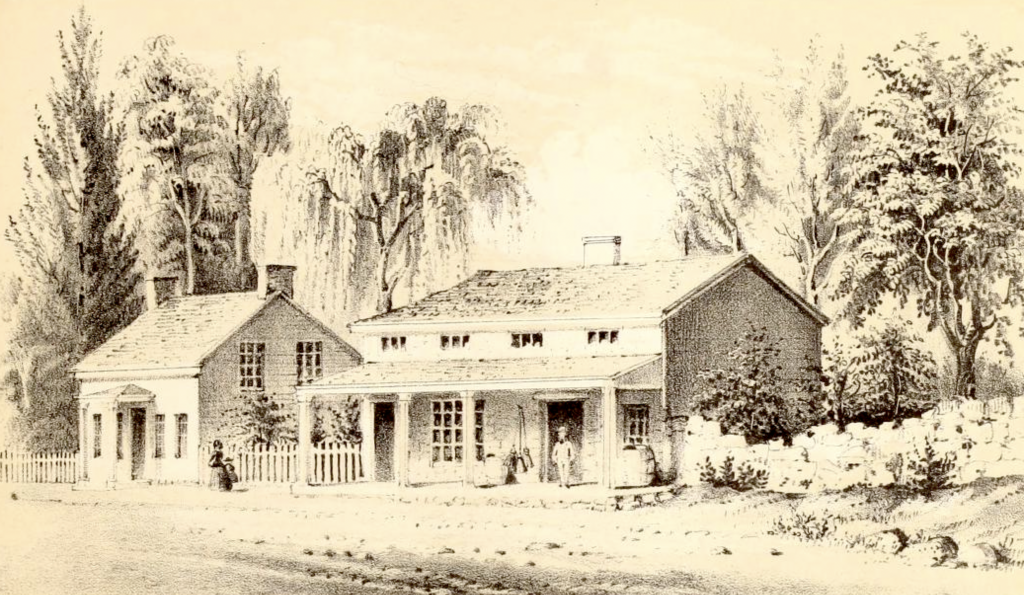
The Blue Bell Tavern, located along the west side of the old Kingsbridge Road, as it looked in colonial times. It was demolished to make way for a theater, which has in turn been demolished, leaving the lot largely empty. From Old New York by L. Bayard Smith.
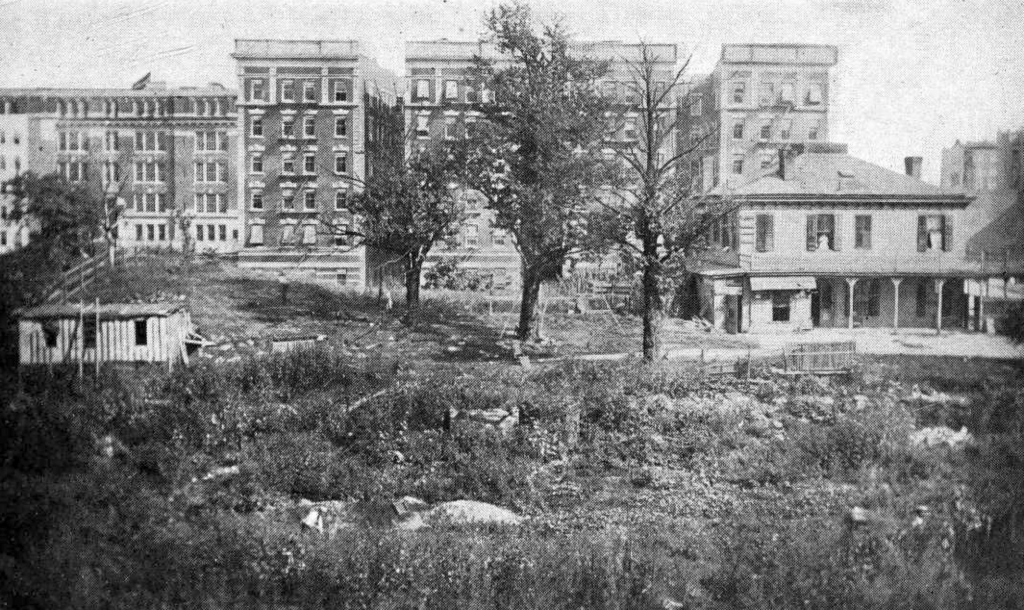
A view looking east from Bennett Place, c. 1912. The remnants of old Sherman Creek, in the foreground, still yielded some Revolutionary War treasures to seekers. The buildings seen in the background still stand along Broadway. From Washington Heights Manhattan, Its Eventful Past by Reginald Pelham Bolton, 1924.
Some members of the crowd kept pieces of the statue as souvenirs, and parts of it have cropped up over the years, including the tail of the horse, which is currently in the collection of The New York Historical. While Washington acknowledged that the soldiers were “actuated by zeal,” and firmly disapproved of this behavior, they continued to tear down signage and the arms of the king. Of course, it would only be a few weeks after this when the Howes launched their fateful invasion of Long Island, leading to the Battle of Brooklyn, the largest engagement of the war.