Last year I read Candice Millard’s excellent Destiny of the Republic: A Tale of Madness, Medicine and the Murder of a President, and I was delighted to find out that it had been picked up by Netflix for a limited series. I recently blew through the four episodes, and I was incredibly impressed with the casting (one can never have enough Nick Offerman-as-Chester A. Arthur-as-Nick Offerman). While the show centers around James A. Garfield, the “man from Ohio,” some of the action is also set in New York City, and I thought it would be interesting to discuss a few things that stood out.

A cartoon from Puck magazine, showing Guiteau as a “model office seeker.” The magazine writers, clearly disillusioned with the spoils system, wrote “…we think that Mr. Guiteau, if he had been fortunate enough to get such an appointment [for a counselship], would have been no worse and no better than the majority of American counsels.” From Puck, July 13, 1881.
Constructing the Brooklyn Bridge

Panorama of lower Manhattan taken from the Brooklyn tower, showing the progress being made on the Manhattan tower of the Brooklyn Bridge, 1876. From Valentine’s Manual of the City of New York 1917-1918, edited by Henry Collins Brown.
In the first episode, we see Charles J. Guiteau in New York City, and there is an excellent shot of the Brooklyn Bridge under construction in the background. An act to incorporate the New York Bridge Company, for “the purpose of constructing and maintaining a bridge over the East River, between the cities of New York and Brooklyn” was passed in 1867. The company selected engineer John Augustus Roebling for the task of building the bridge, although John was involved in a ferry accident and died from his wounds. His son Washington took over, with the immense help of his wife Emily, who would go on to direct construction of the bridge after Washington was stricken with the bends from working in the caissons below the river.


Suspension of the floor beams for the roadway (top), and detail showing the construction process (bottom). At the time, the bridge was often called the East River Bridge. From Scientific American, May 21, 1881.
From mid 1880 to early 1881, when Guiteau was in the city, he would have seen progress being made on the Brooklyn Bridge. By this time, the towers were completed, the strong wire cables had all been strung across the span, and work was continuing on the roadway. Construction was expectantly watched by New Yorkers and visitors alike, who were eagerly awaiting the completion of the bridge that would connect the twin cities of Brooklyn and New York.
The Tombs

Scenes at the Tombs, 1870. Guiteau was likely housed on the top floor with those who committed petty crimes. From Harper’s Weekly, March 26, 1870.
We briefly see Guiteau carted into The Tombs, which was the most infamous prison in the city. The squat Egyptian Revival structure, opened in 1838, was built on poorly infilled land, and the weight of the building caused it to sink. The facade and floors cracked, letting water and vermin in, and prisoners were kept in badly crowded conditions. According to a relative of his who helped him get released, Guiteau was there for not paying his rent, although he later denied this. However, the timeframe of this has been modified, as Guiteau spent a month in the Tombs in 1874, six years before the events of the show began.
The Fifth Avenue Hotel

The Madison Cottage, Colonel Thompson, proprietor. It was located at a busy junction, and people could take stagecoaches from here to points north. From Glimpses of Old New York by Henry Collins Brown.
This irregular plot of land, diagonal on one side where Broadway continues its journey north, was once the site of the famous Madison Cottage, a well-known tavern. The structure dated to 1716 and was originally located just to the south, right in the path of 5th Avenue and 23rd Street, and it can be seen in the Randel Farm Map. It was moved and later leased to Corporal William Thompson, who opened up an inn named after President Madison. It was a stopping point for stagecoaches heading up the Bloomingdale or Boston Post Roads, and many folks spent hours on its wide veranda, discussing politics and other matters of the day. A cattle market was held on a nearby plot of land, and the tavern attracted those interested in coaching, racing horses, and attending cock-fights at the tavern.

Franconi’s Hippodrome. From The Greatest Street in the World by Stephen Jenkins.
In 1852, the old building was razed and became the site of the short-lived Franconi’s Hippodrome. It was conveniently located right across the street from the new Madison Square Park, which opened in 1847 on the old city parade ground. Modeled on a Roman arena, the hippodrome had a massive canvas-topped amphitheater that could seat 10,000 people and included attractions like chariot races and jousting tournaments. Although it was popular when it first opened, it failed to attract steady customers, and it went bankrupt after three years.

Buildings on the “cowcatcher” plot that would later be the site of the Flatiron Building, c. 1885. At times, a screen was put up on the larger building and a magic lantern projector enlarged slides with pictures, news, and ads. From Fifth Avenue, Old and New, 1824-1924 by Henry Collins Brown.
In 1856, dry-goods magnate and real estate speculator Amos Eno bought the lot and razed the hippodrome. He planned on building a luxurious hotel on the site, although his task was beset with difficulties and construction languished as a result of the Panic of 1857. Designed by William Washburn, the hotel was finally completed in 1859; Eno also bought the “cowcatcher” plot of land between Broadway and Fifth Avenue, which would later be the site of the Flatiron Building. Detractors ridiculed the whole hotel project, dubbing it “Eno’s Folly,” as they thought that people would not venture so far north.


The exterior view of the Fifth Avenue Hotel (top) and its elegantly appointed dining room (bottom). From Harper’s Weekly, October 1, 1859.
Eno made sure that the grand Italianate-style hotel, six stories high and faced in brilliant white marble, provided the most luxurious accommodations in the city, with sumptuous finishes and all of the modern comforts for guests. It included a “vertical railway,” the first passenger elevator ever installed in a hotel. Under the watchful eye of hotelier Paran Stevens, it became wildly popular, and was soon the place for visitors to see and be seen. Many dignitaries stayed there during their visits to New York, including Abraham Lincoln, the Prince of Wales, and Ulysses S. Grant.

A banquet given in honor of General Ulysses S. Grant in November, 1865. Grant generally detested public displays, but generously received visitors and well-wishers at this event. He was familiar with the hotel, and would often stay there when visiting the city. This was also supposedly where the plan to have him nominated for President was concocted. From Harper’s Weekly, December 9, 1865.
In 1880, the hotel was the site of a summit held by the Republican Party, then deeply in turmoil following the presidential nomination of James A. Garfield. Garfield arrived from Ohio to meet with Chester A. Arthur and other party leaders, although the irascible Roscoe Conkling was glaringly absent. However, following the meeting, the party threw a rally in Madison Square Park and Garfield delivered a speech to 50,000 people, one of his few campaign appearances.

The beginning of Garfield’s speech, the full text of which can be read here. From The New York Times, August 7, 1880.
Madison Square Garden

The first Madison Square Garden, 1885. After its use by P.T. Barnum, the structure was expanded. However, the construction was shoddy, and part of the facade collapsed in 1880, killing several people. From Valentine’s Manual of Old New York, edited by Henry Collins Brown, 1925.
Madison Square Garden is shown when Garfield is giving the aforementioned “Boys in Blue” speech, but interestingly the one depicted is the second Madison Square Garden (1890). Its distinctive larger tower, which perhaps makes for a better visual, is seen in the background during this scene. However, the Madison Square Garden across from which the Fifth Avenue Hotel stood, facing it and not perpendicular to it as depicted, was the first of the four entertainment venues with that name.
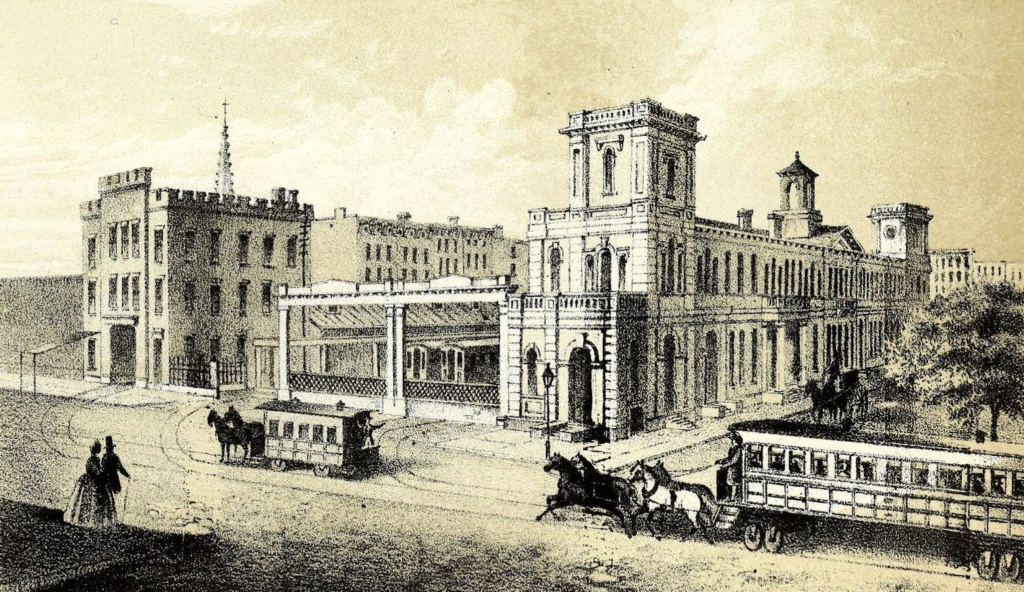
The railroad depot on 27th Street and Fourth Avenue. From Valentine’s Manual of Old New York, edited by D.T. Valentine, 1860.
What later became the first Madison Square Garden was originally a depot used by the The New York and Harlem Railroad, which was chartered in 1831. When steam engines were banned below 32nd Street, the cars were detached and taken to the depot, which had room to store baggage and produce. Following the completion of Grand Central Depot in 1869, the old depot was abandoned. In 1874, the building was leased by P.T. Barnum for his “Great Roman Hippodrome,” which included an animal menagerie, chariot races, and the “Congress of Nations,” an extravagant pageant with representations of both historical and allegorical figures.

An advertisement for P.T. Barnum’s Great Roman Hippodrome. From Harper’s Weekly, June 27, 1874.

The Great Roman Hippodrome as it looked after alterations made by P.T. Barnum. It was also leased by Patrick Gilman and known as Gilman’s Garden. This was the location of the first Westminster Dog Show in 1877, named after the Westminster Hotel. From Valentine’s Manual of Old New York, edited by Henry Collins Brown, 1927.
In 1879, William K. Vanderbilt expanded the old structure and dubbed it Madison Square Garden. It continued on as an events and sporting venue, hosting boxing matches, bicycle races, concerts, and early versions of the “Wild West Show.” This was the venue across from which the Republican summit was held in 1880. The tower of the building was much less commanding than the one depicted in the show.

Madison Square Park and the tower of the second Madison Square Garden, 1906. It was designed by Stanford White, who would be murdered atop its roof garden later that year by Henry Nesbit, enraged that Stanford had prayed upon and assaulted his young wife Evelyn. From An album of selected views of greater New York by Isaac H. Blanchard.
Harry Hill’s Dance Hall

The dance floor at Harry Hill’s. From Lights and Shadows of New York Life by James McNabe.
Located on the corner of Houston and Crosby Streets, Harry Hill’s was a combination dance hall and saloon frequented by Bowery denizens. Women could get into the dance hall for free and men paid twenty five cents for admittance. A sign outside, lit by a large lantern inset with blue and red glass, read “Punches and juleps, cobblers and smashes. To make the tongue waggle with wit’s merry flashes.”

Inside the dance hall. The old building used to have partitions that were removed, and the ceiling had different heights. From Sunshine and Shadow in New York by Matthew Hale Smith.
It also served as an entertainment venue, with concerts, puppet shows, performances by comedians, and boxing matches. In 1879, a “novel and nonsensical” boxing match was held between Nelly Saunders and Rose Harland, with Saunders taking a $200 prize after besting Harland. The main room had benches on the side, and women in bright dresses would approach men for a dance before they retired together to the dance hall’s dark corners.

Scenes of the entertainments at Harry Hill’s. From Muldoon, The Solid Man of Sport by Edward Van Every.
In the show, we see Harry Hill’s portrayed as a haunt of Chester A. Arthur. Arthur was a well-known drinker and gambler, and it was common for men to visit these kinds of dives and party late until the night. Arthur may very well have frequented Hill’s dance hall along with his cronies and other beneficiaries of the infamous “spoils system.’
Roscoe Conkling

A cartoon showing Conkling driving the Grant train to the Republican National Convention in Chicago (after running over the allegorical representation of the Republican party). A sign reads “Third term crossing – Look out for the machine!” From Puck, May 26, 1880.
Roscoe Conkling was a character by all measures of the word, and was a massive force in New York politics leading up to and after the Civil War. He achieved tremendous power through his machinations with the Port of New York and the New York Customs House, of which he was given control by his close ally Ulysses S. Grant. Conkling placed Chester A. Arthur in control of the Customs House, which irked then-President Rutherford B. Hayes, who fired Arthur as soon as he could.

A cartoon showing Roscoe Conkling and James G. Blaine, dressed in togas, pulling the chair of the President in an effort to control the White House. From Harper’s Weekly, May 14, 1881.
Conkling was the type of man with many political enemies, including Senator James G. Blaine, which is something that is portrayed well within the show. Their long-running feud saw them on opposing sides of the increasing divide between the Republican “Stalwarts” and “Half-Breeds,” which came to a head during the 1880 Republican Convention, and left an opening for the “man from Ohio” to secure the nomination. In order to appease Conkling, Arthur was selected as Garfield’s running mate, although, as was aptly shown, the relations between the men were cool at best.

The statue of Roscoe Conkling, sculpted by John Quincy Adams Ward, which stands in Madison Square Park. From Statues of New York by John Sanford Saltus.
However, in the months following Garfield’s inauguration, Conkling made an incredibly shortsighted move when he convinced a Senate colleague of his to resign in protest with him. He expected that the two would be swiftly reappointed to their seats, but this did not occur, and marked an ignominious end to the political career of the former power broker. Conkling retired into relative obscurity, practicing law in the city. During the Blizzard of 1888, he proceeded to his Wall Street office, and left in the thick of the storm. He made his way up Broadway and to Union Square, although there he got stuck in the immense snow drifts. Although he eventually made his way to safety, the ordeal took its toll on him, and he died several weeks later.

A sketch of people trying to make their way through Union Square during the thick of the blizzard. From Harper’s Weekly, March 24, 1888.