Flag Day commemorates the day in 1777 when the Second Continental Congress officially adopted a new flag, with thirteen red and white stripes and thirteen stars on a blue field, representing a new constellation. It was first displayed in August 1777 at Fort Schuyler in upstate NewYork, raised by Peter Gansevoort, Jr. and Marinus Willett.
Some states celebrated the centennial of the adoption of the flag, although it was not until 1916 that President Woodrow Wilson issued a proclamation establishing June 14th as Flag Day. It was officially designated as such by President Harry S. Truman in 1949.
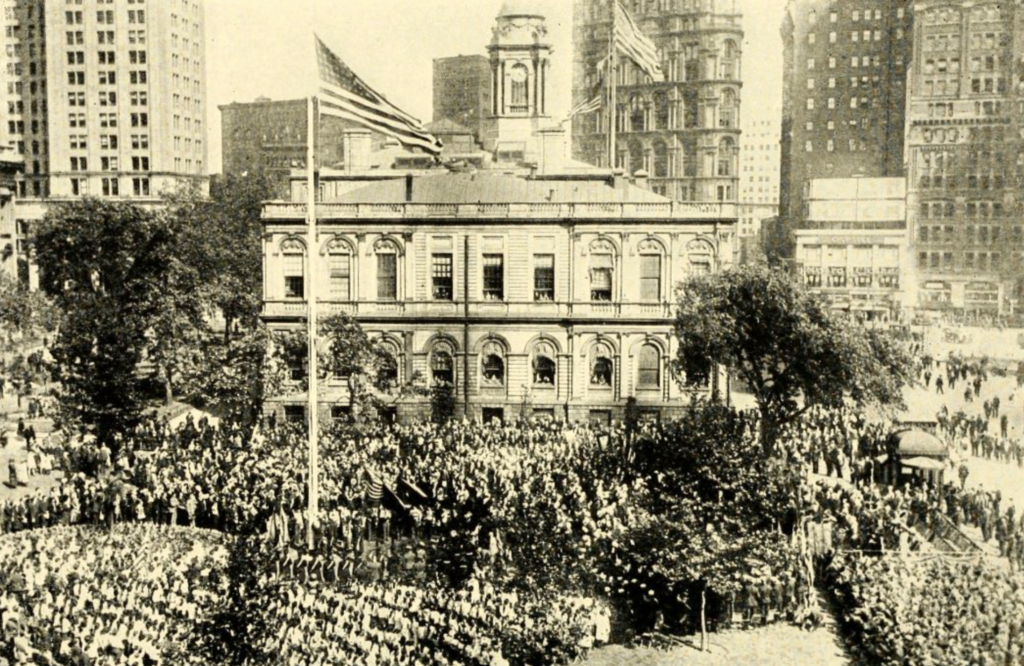
Dedication of a new liberty pole on Flag Day, June 14th, 1921. From Valentine’s Manual of the City of New York, edited by Henry Collins Brown, 1919.
Officials walked up to City Hall Park from Fraunces Tavern, accompanied by veterans, members of the Sons of the American Revolution, and representatives from the New-York Historical Society. An estimated 10,000 people gathered nearby to watch the ceremony..
The pole, 64 feet high and topped by a 22 foot-long brass weather vane with “Liberty” cut out, is a replica of the fifth liberty pole built nearby on what was then the city commons, the first of which was erected in 1766. The poles were repeatedly torn down by the British, leading to several confrontations between the soldiers and the Sons of Liberty. The latter continued putting up the poles, with the final of these standing from 1770 until the British took over New-York in 1776.
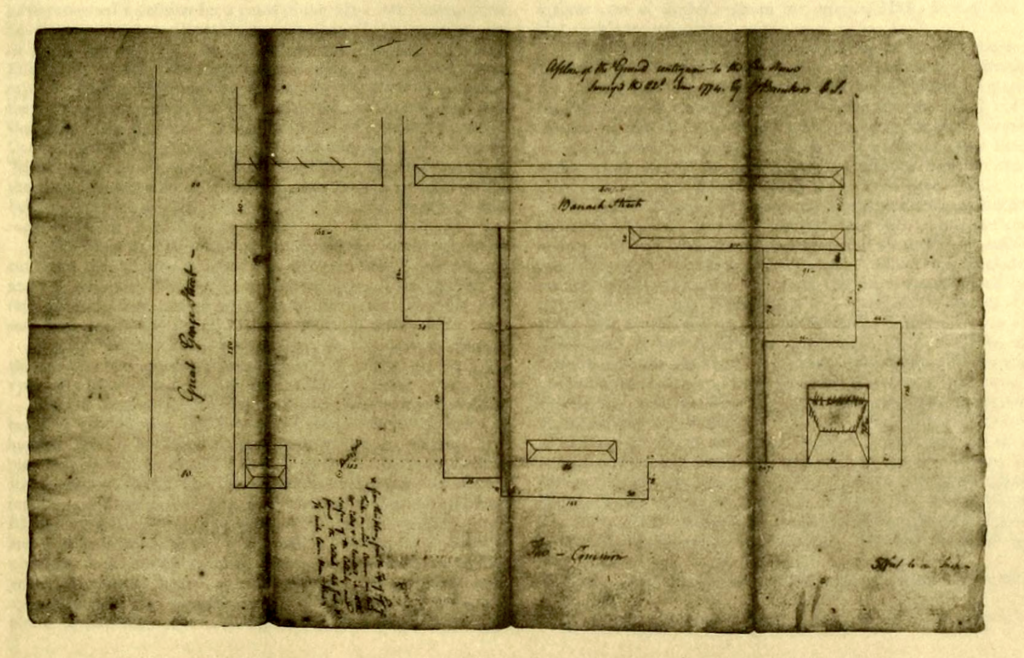
A map drawn by Gerard Bancker, “A Plan of the Ground Contiguous to the Poor House,” 1774. It shows the location of the fifth liberty pole on the lower left (above the handwritten note). From Iconography of the City of New York, Volume 4 by I.N. Phelps Stokes, 1915.
New York City and Manhattan
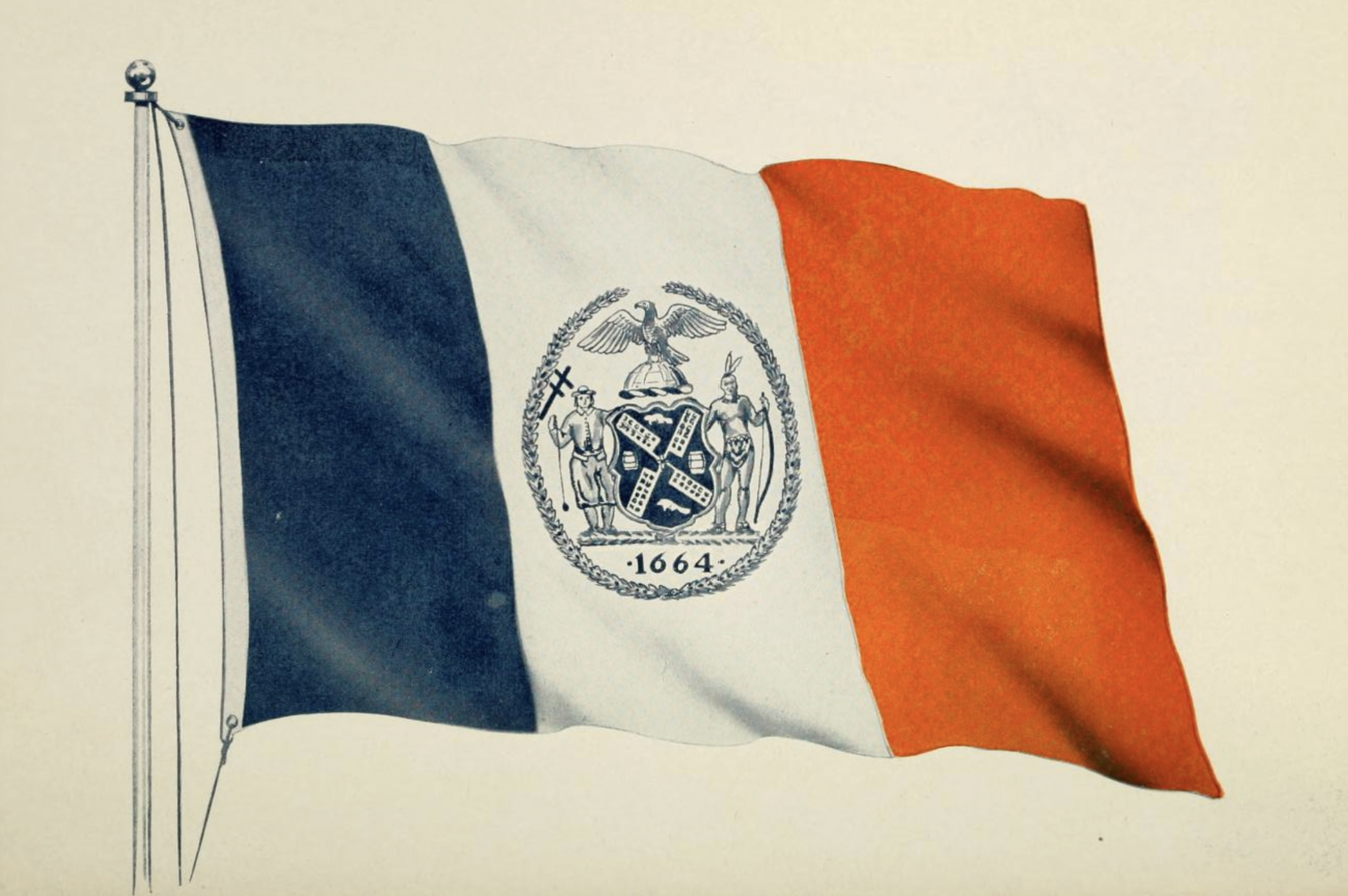
The flag of New York City as adopted in 1915. From Seal and flag of the city of New York by John B. Pine.
For much of New York City’s history, its flag was quite simple, with only the city seal upon it, which was established in 1686. On the left is a sailor holding a plumb bob with a cross staff nearby, both instruments of navigation). On the right side is a native holding a bow, and together they are standing on a laurel, a symbol of triumph and victory. Between them is a shield with a windmill, recalling New Amsterdam and the Dutch origins of the city. There are also barrels of flour and two beavers between the sails, as both were important trade goods that helped finance the city.
A crown once topped the seal, but in 1784 this was changed to a bald eagle atop a hemisphere. The seal also includes the words “Sigillum Civitatis Novi Eboraci,” meaning Seal of the City of New York. It wasn’t until 1915 that the city adopted an official flag, with the seal in the middle in blue on a white background, flanked by blue and orange bars, representing the old colors of the Dutch flag.
Until 1974, the flag included 1664, the date that the British took over, but that year it was changed to 1625. However, the decision to select that date was largely arbitrary. The first settlers arrived in 1624, and it was in 1626 that Director-General Peter Minuit allegedly bought the island of Manhattan. The Manhattan borough flag is quite similar to the city flag. It includes “Borough of Manhattan,” two stars, and the date of November 1st, 1683, which represents the date that Manhattan was incorporated as one of the 12 counties of New York State.
The Bronx
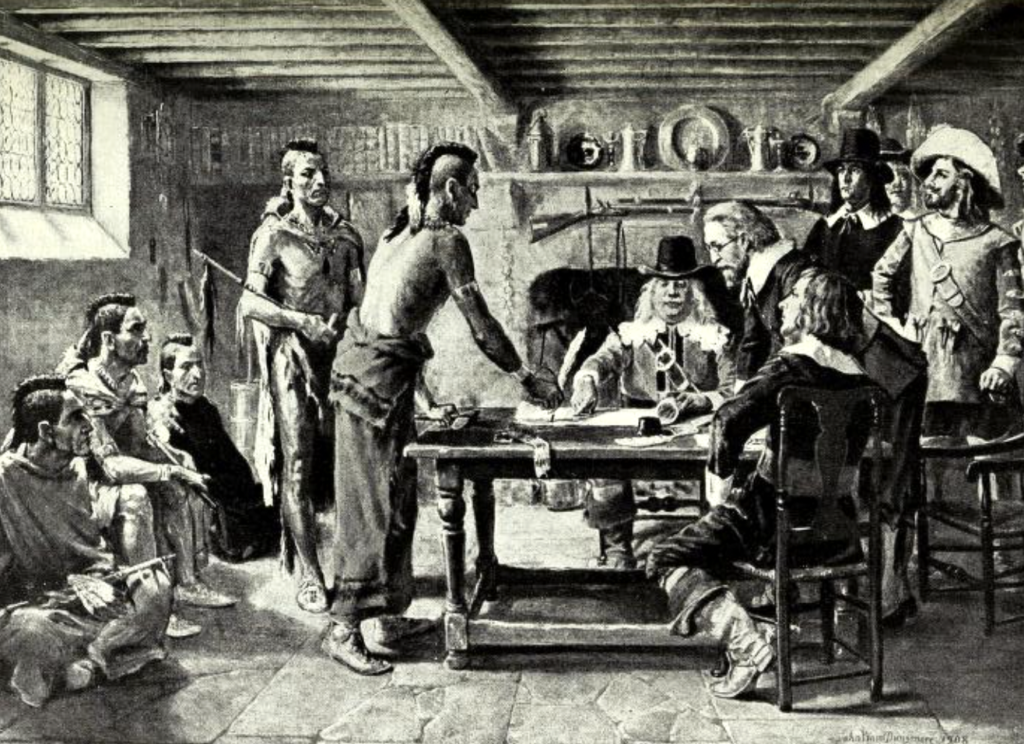
The signing of a peace treaty between representatives of the Dutch and natives at the house of Jonas Bronck, 1642. Bronck is portrayed with glasses, intently viewing the process. From The story of the Bronx from the purchase made by the Dutch from the Indians in 1639 to the present day by Stephen Jenkins.
In 1639, settler Jonas Bronck purchased 500 acres of land from natives. The natives called the area Ranachqua, “the end place,” and the river that would also bear Bronck’s name was known as Aquahung, “river of high bluffs.” Bronk called his estate Emmaus, after a place in the Bible, and constructed his house overlooking the Bronx Kill and Hell Gate, near what is now 132nd Street and Lincoln Avenue. Other settlers started calling the area Bronck’s Land, which was later Anglicized to the Bronx. Bronck was successful in trading beaver pelts and had a grand plan to grow tobacco on his farm, but this was cut short by his premature death. His family’s motto was Ne Cede Malis, “do not yield to evil,” a quote from Virgil’s Aeneid.
In 1912, Bronx Borough President Cyrus C. Miller adopted this for the borough’s new flag. The flag, designed by August W. Schlemmer, contained much of the imagery of the Bronck family crest. The shield contains a sun, representing liberty, rising over the sea, representing commerce. An eagle on a hemisphere tops the shield, with it facing east, wings outstretched. This represents looking back towards the old world, with one foot in the new. The scene is surrounded by a laurel wreath, symbolizing triumph and victory.
The background of the flag has three stripes, but in contrast to the city flag, they are oriented horizontally. This and the lighter shade of blue on the flag recalls the Prinsenvlag, “Prince’s flag,” as it was used by William I, the Prince of Orange.
Brooklyn
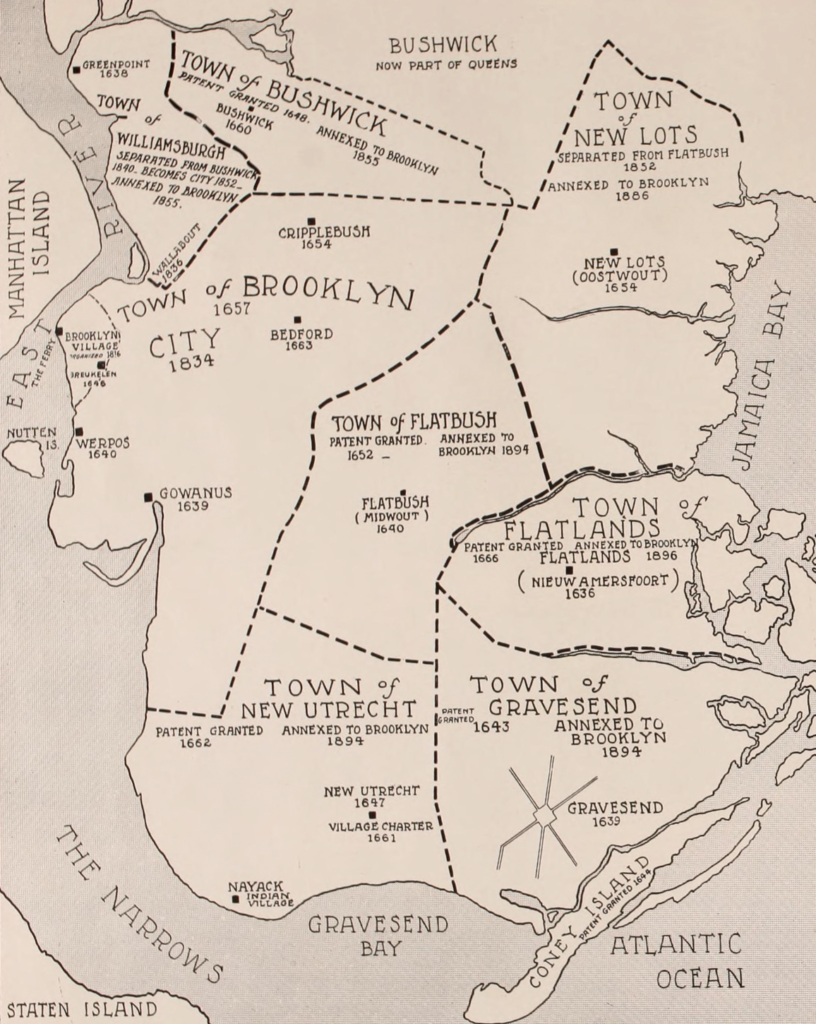
A map showing the locations of the original six towns in what is now Brooklyn. From the Pictorial History of Brooklyn, issued by the Brooklyn Daily Eagle on its seventy-fifth anniversary, 1916.
The land that is now Brooklyn once had six separate settlements, five of which were Dutch, with one, Gravesend, being English. These included Nieuw Amersfoort (Flatlands, incorporated in 1636), s’Gravenzende (Gravesend, founded in 1643 by Lady Deborah Moody, the first woman to be granted settlement in the New World), Breuckelen (Brooklyn, founded in 1646), Vlackebos (Flatbush, incorporated in 1651), Nieuw Utrecht (incorporated in 1652), and Boswijck (Bushwick, the last of the Dutch towns, founded in 1661).
Brooklyn was the largest of these towns, and was officially incorporated as a village in 1816, and then as a city in 1834. Around 1860, an official flag was fashioned, drawing upon the city’s Dutch history. Its motto is Een Draght Mackt Maght, “in unity there is strength.”
On the flag, this motto surrounds the goddess Vesta, dressed in Roman robes, holding a fasces (rods surrounding an axe), symbolizing might, power, and justice. The old flag was black on a white background, and included the names of the original six towns. When it was adopted as the borough flag, the flag was updated to include color. Blue and gold are the official colors of both New York State and Brooklyn.
Queens
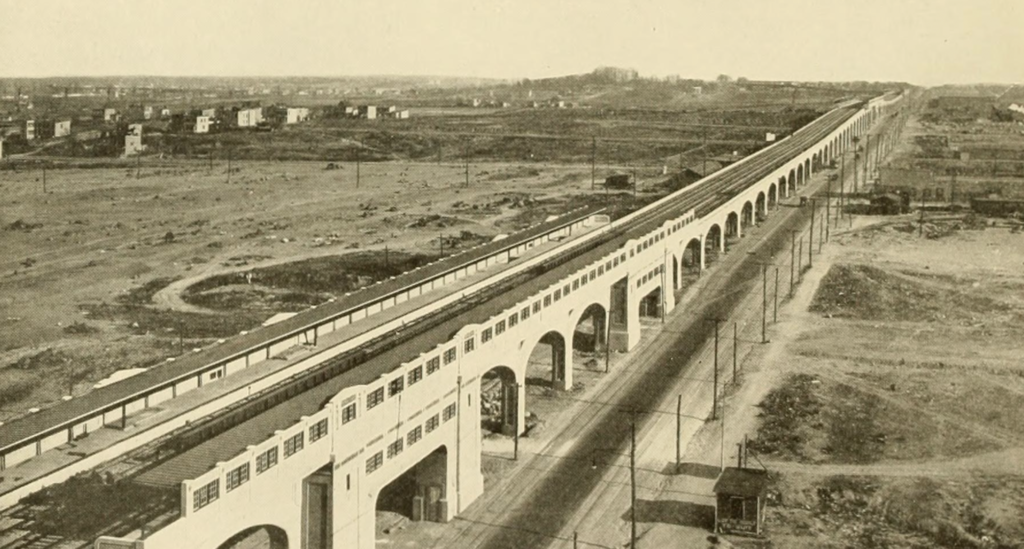
The subway viaduct over Queens Boulevard nearing completion, 1917. Most of the surrounding lots are still empty, although that would quickly change once the line opened. From Queens Borough, New York City, 1910-1920 by the Queens Chamber of Commerce.
Europeans first started settling in Queens around 1636. In 1642, Director General Willem Kieft gave Francis Doughty a patent to settle Mespat, what the natives called the “bad water place,” which was later Anglicized to Maspeth, but the settlement was destroyed during Kieft’s War. Other towns soon sprang up, including Middleburgh (Newtown), Vlissingen (Flushing), and Rustdorp (Jamaica).
Queens, which was originally much larger and included what is now Nassau County, was incorporated as a county of the Province of New York on November 1st, 1683 along with New York and Kings county. Jamaica was made its seat, as it was accessible via the King’s Highway, today’s Jamaica Avenue. Although the western area of Queens, including Long Island City, incorporated in 1870, became industrialized in the years after the Civil War, much of Queens remained heavily rural well into the early 20th Century, as it was a major source of fresh food (the first commercial nursery in America was founded in Flushing in 1737!).
When it was consolidated into Greater New York, it had a collection of towns, each with their own street grids, and the attempt to standardize these streets is one of the reasons why Queens can be particularly difficult to navigate. In 1913, Queens Borough President Maurice E. Connolly and the Queens Borough Chamber of Commerce tasked the American Scenic and Preservation Society with coming up with an official flag for the borough to celebrate the signing of the Dual Contracts, which would bring new subway lines into Queens.
The design included three horizontal stripes, two blue and one white, which evoked the coat-of-arms of Willem Kieft, who had made the first sanctioned land grant in 1642. On the background are two flowers, an orange tulip representing the Dutch, and a red rose (also known as the Tudor rose) representing the British. They are surrounded by beads of wampum, which was the first currency used in New Amsterdam. The flag also includes a crown, symbolizing the county, which was named after Catherine of Braganza, who married Charles II and became Queen of England. The date 1898 reflects the consolidation of Greater New York.
Staten Island
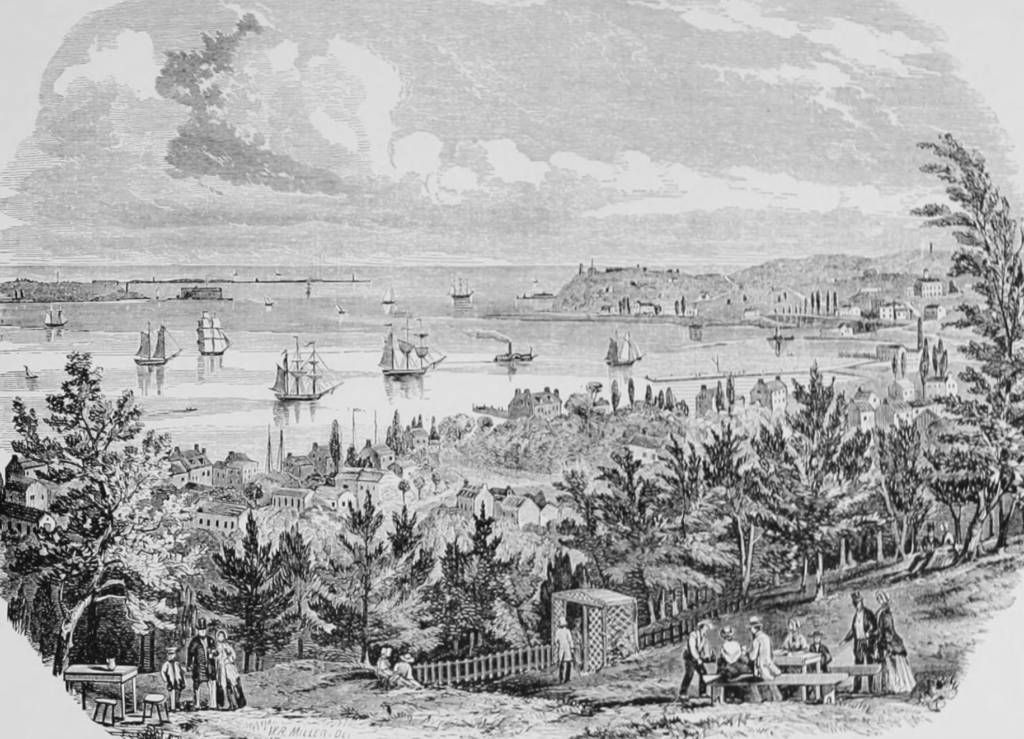
Folks picnicking on Pavilion Hill, 1850. There are many ships going in and out of the harbor. On the left is Fort Lafayette, which once commanded the Narrows. From The New Metropolis, Memorable Events of Three Centuries, 1600-1900 by E. Idell Zeisloft.
Several native tribes shared the use of Staten Island, which they called Eghquaons, “high sandy banks.” The first sale on Staten Island was made to Michael Pauw in 1630. The Dutch also granted several patroonships on the island, a system whereby large tracts of land were given to those who could bring over 50 colonists, although most of them failed, with the exception of Rensselaerwyck upstate.
The first permanent settlement was at Oude Dorp, incorporated in 1661. Staten Island became the county of Richmond in 1683, named after the Duke of Richmond. During the American Revolution, Staten Island had a large Loyalist population, and it was occupied by the British. Following the war, the island became a popular spot for wealthy families to have large estates.
When it was incorporated into Greater New York, it had an orange and blue flag with the dates 1683 and 1898. In 1971, a contest was held to design a new flag. It included the profile of the island, with two birds flying overhead and five waves, symbolizing the five boroughs. This was officially adopted in 2002, but in 2016 a new flag was released. Done in green and beige, the new flag has Columbia, a personification of the United States, looking out across the narrows towards the Half Moon, which arrived in New York Harbor in 1609. It also includes three people picking oysters, which were once the premier delicacy in the city.