
A map of New York City and Manhattan Island, showing the American lines and escape routes up the Post Road on the west, and through Greenwich Village (Monument Lane, now Greenwich Avenue) and up to connect with the Bloomingdale Road on the east. From The Campaign of 1776 Around New York and Brooklyn by Henry P. Johnston.

McGowan’s Pass, 1905. When Central Park was expanded from 106th Street to 110th Street, the additional land included the pass. The British built a redoubt here during the war, and during the War of 1812 the city strengthened the defenses in upper Manhattan, building a gatehouse across the pass, along with Nutter’s Battery and Fort Clinton. One can still walk through the pass today. From McGown’s Pass and Vicinity by Edward Hagaman Hall.
Following the retreat of the American army in the wake of the invasion of Kip’s Bay on September 15th, the beleaguered troops withdrew through McGowan’s Pass on their way to the American lines. This was a natural formation that dipped between the rocks and hills, and through it the Post Road (also called the Kingsbridge Road) ran. The pass, named after the McGowan family, who were proprietors of a tavern overlooking the escarpment, provided a convenient cover for the retreating men, who continued down across the valley and up to the safety of the heights above.

When the Interborough Rapid Transit Company was planning the subway, they were faced with a topographic challenge in upper Manhattan. Ultimately, they decided that it would be easier to have the line cross the Manhattan Valley on a viaduct, seen here under construction in 1903. From The New York Subway Souvenir.
By night, the Americans were situated in a series of parallel lines from the Morris-Jumel Mansion to the edge of the heights overlooking the “Hollow Way.” A fault line crosses the island here on a diagonal, and over millions of years of seismic activity and erosion, a deep valley was created. On the western side of the island, rocky heights bordered the valley, and these dipped down into smaller hills on the south, leading to a bay known as Moertje David’s Vly (which later became the village of Manhattanville). and sandy plains towards the east. These plains were used by the natives for fishing and hunting, and later became the site of a small village that was named Nieuw Haarlem.

The old Apthorp Mansion as it appeared shortly before demolition, 1891. Built in 1764, it stood near 90th Street and Columbus Avenue. From Factory and Industrial Management by John Robertson Dunlap.
The British and Hessians had marched up the Post Road and stopped just short of McGowan’s Pass, spreading out across the island from Hoorn’s Hook on the East River (where Carl Schurz Park is now) towards Striker’s Bay on the banks of the Hudson. General Henry Clinton took Elmwood, owned by Loyalist Charles Ward Apthorp, as his headquarters. Another interesting, although likely untrue story, is that George Washington had occupied the Apthorp mansion earlier that day and left shortly before the British advance guard arrived to seize it, therefore narrowly escaping capture a second time in one day.

The positions of the British and American armies on the night of September 15th, 1776. From Battle of Harlem Heights, September 16, 1776 by Henry Phelps Johnston.
Three American divisions were encamped on the commanding heights, with General Joseph Spencer’s division closest to headquarters, General Nathanael Greene’s division by the Hollow Way, and General Israel Putnam’s division between them. Pickets were established on the southernmost end of the heights to watch McGowan’s Pass and the Hudson River. Washington was expecting a fight, although he took care to avoid a general engagement. However, setting up the lines this way allowed for reinforcements to more easily be deployed in the event that the enemy made a move.

“The Death of General Warren at the Battle of Bunker’s Hill” by John Trumbull. Thomas Knowlton is portrayed on the left in the white shirt, holding the musket. From Paintings by John Trumbull at Yale by John Hill Morgan.
Before dawn on September 16th, a unit of rangers under Lieutenant Colonel Thomas Knowlton embarked on a reconnaissance to the south of Harlem Heights. The rangers were an elite group, composed of hand-selected men from Connecticut, Rhode Island, and Massachusetts. Knowlton had served in the French and Indian War, distinguishing himself at the Battle of Bunker Hill and during a daring raid on Charlestown, and had rightly earned General Washington’s trust.

The Woodlawn Hotel, c. 1850. The house, once owned by Nicholas Jones, had been turned into a hotel, of which there were several others in the area. From D.T. Valentine’s Manual of the Corporation of the City of New York, 1856.
Probing near the Nicholas Jones house (located near 106th Street and West End Avenue), the rangers found pickets of the light infantry, Highlanders, and Hessian riflemen who had come up the Bloomingdale Road from their camp near the Apthorp mansion. The rangers fired upon them, and then took position behind a wall on the property, unleashing several more volleys to great effect. Following this, Knowlton wisely retreated, as his men were outnumbered.

A map showing McGowan’s Pass and upper Manhattan. Some of the key points of interest and orientation include: 1. The Point of Rocks; 2. An American redoubt on the heights; 3. Moertje David’s Vly (Manhattanville); 5. Grant’s Tomb; 10. The site of the buckwheat field (now Barnard); 11. The site of Columbia; 14. St. John the Divine; 21-24. McGowan’s Pass and fortifications (some were built by the British during the Revolutionary War and others by the city in 1812). From McGown’s Pass and Vicinity by Edward Hagaman Hall.
Writing letters at the Morris-Jumel mansion that morning, including an important update for Congress, Washington had just sent them off when the fighting erupted. Joseph Reed, his Adjutant-General, had heard the commotion and witnessed the rangers falling back. However, the enemy were close on their heels. As they emerged from the woods on the hill across the way (sometimes called Vandewater’s Heights, now Morningside Heights), some of them taunted the Americans with bugle calls.

Site of the flanking attack, seen in 1897. Grant’s Tomb is nearing completion, and a street has been cut through the bedrock. From the Battle of Harlem Heights, September 16, 1776 by Henry Phelps Johnston.
Discerning from Knowlton that the smaller force was cut off from the main army, Washington came up with a feint to draw the enemy towards the Americans. As part of the feint, the rangers, joined by three companies of Virginians under Major Andrew Leitch, would work to encircle the enemy. Lieutenant Colonel Archibald Crary and 150 men volunteered to demonstrate in front of the enemy, and this was enough to entice them down the hill towards the Hollow Way.
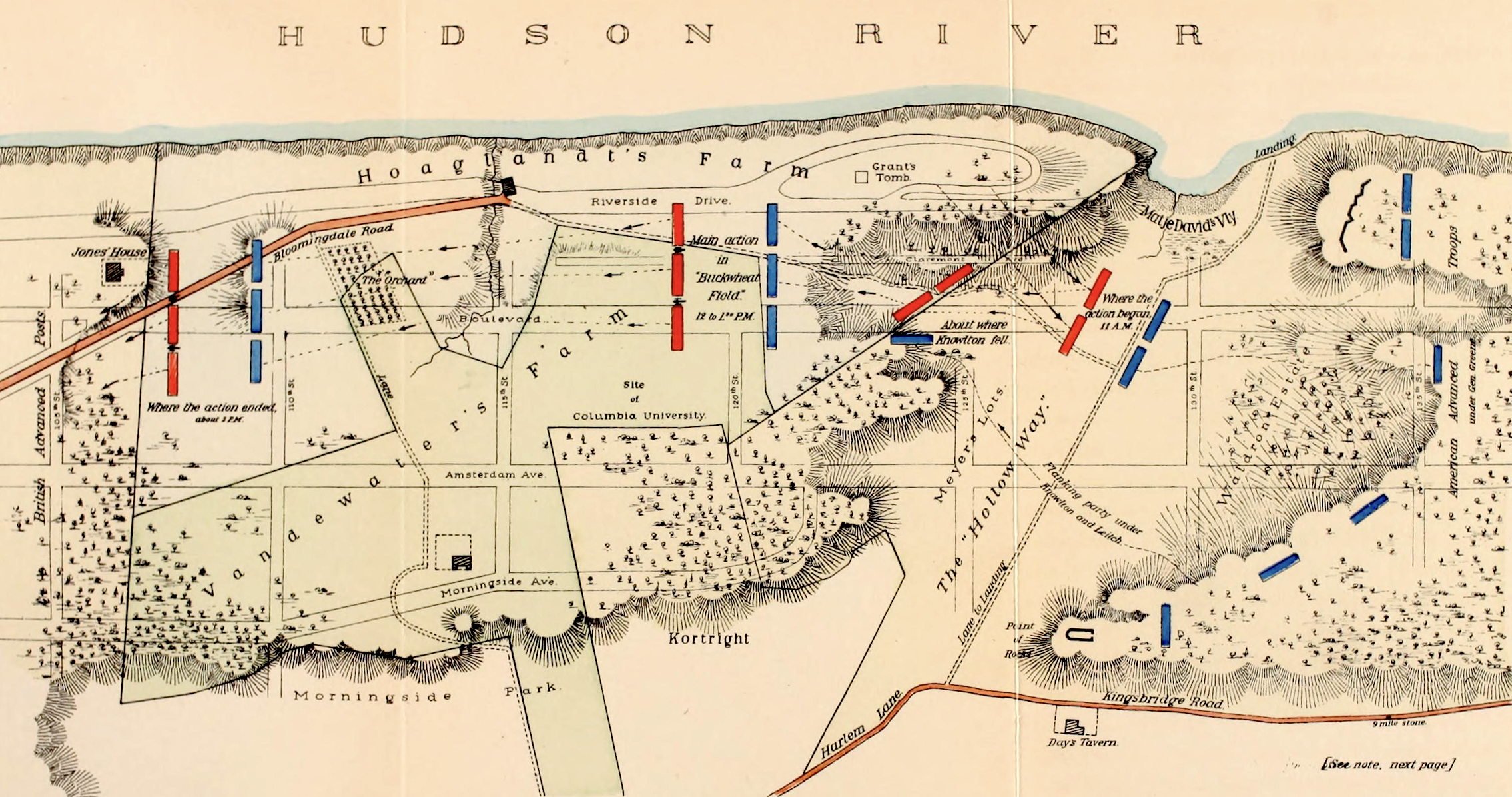
A battle map of the Battle of Harlem Heights. It shows the route that Knowlton and Leitch took in the attempted flanking maneuver, and how the Americans pushed the enemy back. From the Battle of Harlem Heights, September 16, 1776 by Henry Phelps Johnston.
The British spread out among fences and bushes at the foot of the hill, and the American volunteers fired upon them from a longer distance to allow the flanking party time to get into position in the woods. Washington periodically ordered reinforcements to the Hollow Way to bolster their numbers. Unfortunately for the Americans, the plan went amiss when some of Knowlton and Leitch’s soldiers fired too soon, and instead of being behind the enemy, they were instead on their flank. Easily spotted, they faced a withering fire, and several were soon killed or wounded, including both Knowlton, who died later in the day, and Leitch, who lingered on for several weeks before succumbing to his wounds.

The “Point of Rocks,” located around 128th Street and St Nicholas Terrace. From New Harlem past and present by Carl Horton Pierce.
Watching the action from the “Point of Rocks” on the extreme end of the heights, Washington continued to order men to reinforce Crary. This contingent, now nearing 1,800 men, was able to force the enemy back up the hill and on towards one field, and then a second field filled with buckwheat. Field pieces were dragged up the hill to oppose those fired by the enemy, and this helped as the Americans made their stand. The fighting raged for well over an hour, but the Americans held their own.

The Battle of Harlem Heights, drawn by Alonzo Chappel. From History of New York City from the Discovery to the Present Day by William Leete Stone.
Eventually, the British fell back again, and the Americans pursued them through an orchard and towards the Jones House, where the first skirmish had occurred that morning. However, Washington was concerned that the British could quickly bring up reinforcements from their lines, which were much closer to the action than the American ones. The enemy had also retreated to a small hill, and since that position was more advantageous, Washington took the more prudent route and ordered a retreat.

Site of the buckwheat field, which saw some of the most ferocious fighting during the battle, allowing the Americans to regain some of their confidence and pride. This view, from 1897, is looking north from 106th Street towards Barnard, with Grant’s Tomb behind. From Historic New York, the Half Moon Papers by Maud Wilder.
Despite being a relatively small battle with no strategic gain, and one where the loss of Knowlton was particularly bitter, it offered a much-needed boost of morale for the Americans. Reed wrote that “the men have recovered their spirits, and feel a confidence which before they had quite lost.” According to General George Clinton, “I consider our success in this small affair, at this time, almost equal to a victory.” Washington, although he thought that the engagement was little more than “some smart skirmishes,” also noted that the battle “greatly inspirited the whole of our Troops.”
Gotham: A History of New York City to 1898 (The History of New York Series) by Edwin G. Burrows and Mike Wallace
Unnatural Rebellion: Loyalists in New York City during the Revolution by Ruma Chopra
Harlem: The Four Hundred Year History from Dutch Village to Capital of Black America by Jonathan Gill
1776 by David McCullough
The Battle for New York: The City at the Heart of the American Revolution by Barnet Schecter
Generous Enemies: Patriots and Loyalists in Revolutionary New York by Judith L. Van Buskirk